Zachary Svajda's long road from junior champ to the ATP's Top 100
Indian Wells, Calif. – The unnerving crack of a racquet smashed to smithereens is often the sound of success.
Zachary Svajda didn’t see it, but the echo reverberated loud and clear during his first-round victory against 2014 US Open champion Marin Cilic of Croatia Wednesday night at the BNP Paribas Open.
The racquet abuse occurred with Svajda leading, 4-2, in the second set of a 7-6(5), 6-4 win.
“I heard it because my back was turned, but, yeah, one smash,” he said with a grin on Wednesday.
For Svajda, a main-draw wild card recipient, the moment captured more than a single outburst from a frustrated opponent. It signaled that the 23-year-old Californian is continuing to find his footing on the ATP Tour with steady progress and persistence.
Long considered one of the most promising American prospects of his generation, Svajda has built his reputation on patience and a grounded approach to development.
“I just try to stay calm, and I felt good out there,” he said of his opening-round win.
 Zachary Svajda debuted inside the Top 100 of the ATP Rankings on Feb. 23. Photo by Sam Hodde/Getty Images.
The La Jolla native first gained attention as a teenager when he received a wild card into the 2019 US Open main draw at 16 years old by winning the USTA Boys' 18s Nationals—an event he won again in 2021, defeating Ben Shelton to punch another ticket to New York.
Since then, his journey has unfolded largely away from the spotlight, with countless matches across the Challenger circuit incrementally sharpening both his game and his confidence.
That grind paid dividends in recent seasons. Svajda has collected multiple Challenger titles and steadily climbed the rankings, proving he can translate his junior promise into professional results.
But he’s increasingly finding himself on the sport’s bigger stages.
At the start of 2026, he won three matches to qualify for the Australian Open main draw for the first time. Though he lost to veteran Yannick Hanfmann of Germany, he rebounded back in the States by winning his hometown Challenger at San Diego, besting fellow American Sebastian Korda in the final. Korda picked up his third ATP title at Delray Beach three weeks later.
“My mom came down, my brother was there, and a lot of family friends, and that was a really special week for me,” says the 99th-ranked Svajda.
“It definitely gave me a lot of confidence to start the year.”
 Svajda at the 2025 US Open. Photo by Darren Carroll/USTA.
The string of wins finally pushed him into the Top 100 for the first time in February.
According to David Nainkin, a longtime USTA coach who works closely with Svajda along with his primary coach Raymond Sarmiento, the young American has improved key elements of his game over the past year, particularly his serve and forehand.
A small equipment adjustment also played a role, with Svajda moving to a denser string pattern and lowering the tension in his racquet to help generate more control and pop. Those technical gains have translated into more firepower.
Nainkin noted that the 5-foot-9 Svajda’s serve is now regularly reaching around 130 mph and touching higher numbers, giving him a weapon to complement the foot speed, baseline consistency and counterpunching skills that have long been his foundation.
With a bigger serve and a more assertive forehand, Svajda has been able to hold his own against higher-ranked opponents and maintain pressure throughout matches.
His resilience has been just as significant as the technical progress.
Svajda’s father, Tom, died last fall, and returning to compete in San Diego carried emotional weight. Yet Svajda delivered one of the best performances of his career there.
For Nainkin, the result was both impressive and fitting given Svajda’s long-recognized talent.
“Everyone was kind of waiting for Zach to kind of play to his potential and get into the Top 100, and then we will see how it goes from there.”
Svajda agreed, noting that cracking triple digits in the rankings puts his ambitions in a different light.
“We definitely have more goals throughout the year like getting to a certain round of a Slam or Masters, and higher ranking too,” Svajda says, while not getting ahead of himself and staying “present.”
There is also motivation closer to home. Trevor Svajda, a 19-year-old sophomore at Southern Methodist University who also competes at some pro-level events, lost in the final round of Indian Wells qualifying earlier this week.
“It’s so nice to see he's been doing really well in college, and a little bit on the pro tour as well,” Zachary says. “And we're very close. We call every day.”
While the win against Cilic is just one of many, for a player still establishing himself at the highest level every victory carries weight. Beating a former US Open champion on one of the sport’s biggest stages can reinforce the belief that the years of work are beginning to bear fruit.
“One tournament could change a lot, like ranking-wise and confidence,” he says. “I just try to tell myself that, because pretty much you lose like every week in tennis, unless you're [Carlos] Alcaraz.”
Svajda faces Spain’s 18th-seeded Alejandro Davidovich Fokina in the second round on Friday. In their only previous meeting, Davidovich Fokina beat the American last month in Dallas in a tight 6-4, 7-6(1) contest.
For a player still climbing the rankings, those kinds of tests are part of the next step.
If the opening round here is any indication, Svajda appears ready for them, whether the loudest signal comes from the other side of the net or not.
Related Articles
-
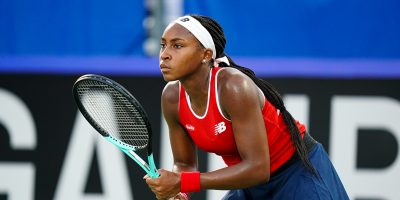
 Gauff to lead BJK Cup teamOctober 07, 2026Two-time Grand Slam singles champion, current world No. 4 and Delray Beach native Coco Gauff will compete for the U.S. Billie Jean King Cup Team as it takes on Hungary in a pivotal Billie Jean King Cup by Gainbridge Playoff competition in Delray Beach, Fla., November 21-22. Read More
 -
![Visit the WTC team announced page]() WTC team announcedAugust 20, 2026The United States Tennis Association (USTA) announced the players and coaches who will represent the United States at the 2026 BNP Paribas World Team Cup, to be held Sept. 16–19 at the USTA National Campus in Orlando, Fla. Read More
WTC team announcedAugust 20, 2026The United States Tennis Association (USTA) announced the players and coaches who will represent the United States at the 2026 BNP Paribas World Team Cup, to be held Sept. 16–19 at the USTA National Campus in Orlando, Fla. Read More -
 BJK Cup Playoffs in DelrayAugust 20, 2026The U.S. Billie Jean Cup Team is bringing the World Cup of Women’s Tennis back to Delray Beach, Fla., as the United States takes on Hungary in a pivotal Billie Jean King Cup by Gainbridge Playoff competition at the Delray Beach Tennis Center November 21-22. Read More

Sign up for our Newsletter
Download the USTA App

