Coach Spotlight: Aki Wolfson

In 1976, Brad Parks and Jeff Minnebraker developed the idea for wheelchair tennis; Parks had been paralyzed in a freeskiing accident and dreamed up the concept while recovering in the hospital. What started as a game Parks and Minnebraker devised on local courts across the street from a medical facility has now become one of the biggest sports in the world for people with disabilities. Wheelchair tennis debuted at the Paralympic Games in Seoul in 1988, has its own professional tour and today is a part of all four Grand Slam tournaments.
To commemorate 50 years of the game, we spoke with Aki Wolfson, one of the most prominent wheelchair tennis coaches in New York. Wolfson—who serves as the director of tennis and programming at the Commonpoint Tennis & Athletic Center in Queens—talks to us about first getting involved in the sport and how it has ultimately transformed her life and worldview.
 Wolfson was one of the recipients of the Champions of Equality Award at the 2025 US Open. The award recognizes leaders and trailblazers who have advanced inclusion, equal opportunity, and equality in sports and society.
You've been coaching wheelchair tennis in the New York area for more than 20 years. What first inspired you to start coaching in the discipline?
WOLFSON: My late mentor, Jana Hunsaker, is the reason I became involved in wheelchair tennis. Jana wasn’t just my boss and the USTA Tennis Director. She was like a second mother to me. She was very passionate about expanding opportunities in tennis, especially by creating wheelchair tennis classes. Working alongside Jana and her incredible students, I found myself becoming more and more involved in wheelchair tennis and adaptive sports. She eventually sent me to several wheelchair tennis camps and helped me earn my certification to teach. From there, I began giving private lessons, traveling locally with players as their tournament coach and assisting with weekly classes while Jana led the way. What started as supporting her vision ultimately became a lifelong commitment of my own. I’ve continued teaching wheelchair tennis every single week for more than 20 years and I haven’t stopped to this very day.
You probably have had so many transformative experiences working with athletes in this discipline. Is there one you can share that really affirmed your commitment to continue coaching?
WOLFSON: One story that will stay with me forever is that of a young college tennis player who had a promising career ahead of him. A freak accident left him quadriplegic, and he fell into a profound depression. I think he believed his life as an athlete was over. His coach at the time heard about wheelchair tennis and reached out to me for an introduction. We met at the US Open, but I could tell immediately that he wasn’t ready to hear anything I had to say. Before leaving, I told him, “Whenever you’re ready, come out to one of our clinics. I can guarantee you will play tennis again.”
Two years later, he showed up to my class in a motorized chair. He explained that he was right‑handed but could no longer hold the racquet, and that he would have to relearn everything as a lefty. I told him we could do even better. We taped the racquet to his right hand and got him into a manual chair. With just a few adjustments, he realized he could play again. The look on his face said everything. That same year, he entered our tournament and played incredibly well. His parents were in tears because it was the first time they had seen him smile since the accident. He eventually went on to earn a high ranking in the Quad division and built an entire new chapter of his life through the sport. Watching him transform from hopeless to hopeful and then to successful was one of the most rewarding moments of my career. It reaffirmed everything I believe about tennis, about adaptive sports and about the resilience of the human spirit.
One of your more recent prominent students was Max Wong, who was part of the US contingent that won the junior world cup title in 2024. How would you characterize your coaching journey with Max?
WOLFSON: Coaching Max has been one of the most meaningful experiences of my career. I remember him starting tennis around ten years old, and he never let being in a wheelchair stop him from being a kid. In fact, he was just like any other energetic ten‑year‑old picking up a racquet for the first time. He would blast the ball as hard as he could and laugh his way through it! Watching him grow from a young beginner into a world‑class junior athlete and now a college player has been an incredible privilege.
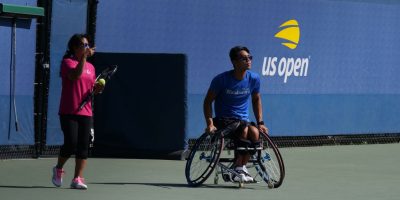
 Wolfson coaches Max Wong, who competed in the 2025 US Open Junior Wheelchair Championships.
What was it like getting to coach him at the 2025 US Open as part of the newly-created junior wheelchair tournament?
WOLFSON: One thing that had always been missing in our coach-student relationship was the chance to actually travel with him to his tournaments. For most of his events, I relied on real‑time play‑by‑play updates from his parents or I watched his matches on my phone. I’d be sitting there, throwing my arms up or yelling at the screen, “Max! We talk about this all the time in our lessons! Why aren’t you doing this or that?” Getting the opportunity to coach him in person at the US Open was something entirely different. It was an amazing feeling. Honestly, I was nervous for him not because I doubted his ability, but because I knew how big the moment was. I could sense his nerves, but I didn’t want to add to them. So I kept it simple. I told him, “Enjoy yourself. Be proud of everything you’ve accomplished to get here. Whatever happens, happens. Just have fun.” My role wasn’t to coach every point. It was to keep him relaxed, grounded, and excited to compete.
Since 2001, you have also served as the tournament director for the Jana Hunsaker Memorial Wheelchair Tennis Tournament, which is based here in New York. What do you enjoy about wearing the tournament director hat for a wheelchair tennis competition?
WOLFSON: What I enjoy most about that is how deeply connected the event is to its history, its players and the community it brings together. When Jana was running the tournament, I watched it grow from a sectional event to a regional competition that drew players from all over the United States. The year she passed away, the tournament was scheduled to become an ITF event, which meant it would welcome athletes from around the world. As time went on, the event grew from 45 players to a record 86 competitors, with athletes traveling from places as far as Australia, Japan and Hawaii. Seeing that growth was incredibly rewarding. It’s become more than a tournament. It’s a reunion, a celebration of wheelchair tennis and a way to carry forward Jana’s legacy year after year. It’s a privilege to help keep that tradition alive.
How has a career in wheelchair tennis changed you and your view of the world?
WOLFSON: It’s truly shaped my character. When I first started, I’ll never forget a moment during a tournament match when one of the players fell out of his chair. My instinct was to run over and help him back in so he could continue playing. But Jana grabbed my arm and said, “He knows how to get back on.” Sure enough, he pulled himself back into his chair and continued the match without hesitation. In that moment, I began to understand the tremendous independence these athletes have developed. People often assume that someone who uses a wheelchair needs constant assistance, but that assumption is so often wrong. I was amazed by how independent, resilient and determined the players were. This experience also made me reflect on my own life. Teaching wheelchair tennis taught me not only about the sport, but also about perseverance, self‑reliance and the importance of seeing people for their abilities rather than their limitations. It opened my eyes to the deeper meaning of adaptive sports and the power of true inclusivity.
 "Seeing the smiles on my students’ faces and watching them gradually improve each week is exactly what every coach hopes to achieve," Wolfson says. Photo Credit: Michael Clubine/Wheelchair Sports Federation
Related Articles
-
 Eastern at the '26 US OpenSeptember 29, 2026Multiple USTA Eastern athletes, including New Jersey's Michael Zheng, scored big wins at the 2026 US Open. Read More
 -
 League Sectional ResultsSeptember 28, 20262026 USTA Eastern League Sectional Championships are in full swing! Throughout the summer, USTA Eastern League teams from all of Eastern’s six regions are competing for the chance to represent the section at the National Championships. Check this page for the latest results, photos and more. Read More
 -
 Spotlight: Aki WolfsonJuly 30, 2026To celebrate 50 years of wheelchair tennis, we spoke with Aki Wolfson—one of the most prominent wheelchair tennis coaches in New York—about her life in the game. Read More

Sign up for our Newsletter
Download the USTA App

