Remembering Doris Herrick

USTA Eastern mourns the loss of its former Executive Director Doris Herrick, who passed away Thursday, August 1 at 96 years old.
Doris was a legendary figure who guided the section for nearly 20 years, from 1978 until 1997. Under her purview, the organization transformed from an association primarily responsible for organizing tournaments to a full-fledged non-profit that developed programming and facilitated community partnerships in an effort to grow the sport at the grassroots level. As she expanded the section’s scope, Doris helped nurture a dedicated, enthusiastic staff and oversaw the implementation of countless programs and initiatives that are commonplace today—USTA Leagues and the USTA’s Schools program chief among them. The organization, quite simply, would not function the way it does today were it not for Doris Herrick.
As a leader, Doris possessed a singular talent for inspiring her employees.
“She mentored me, and I learned so much from her,” said current USTA Eastern Executive Director Jenny Schnitzer, who began working for the organization right out of college in 1992. “Doris knew when to listen and when to be compassionate. On the other end, when she had a direction, there was no stopping her. I will always remember Doris for her strength, dignity, spirit and her special smile.”
Our thoughts are with Doris’s friends and family.
Below, we have re-published the feature written by Nancy Gill McShea in honor of Doris’s 2000 induction into the Eastern Tennis Hall of Fame.
Doris Herrick (2000)
If presidential hopefuls Al Gore and George W. Bush are compiling a list of potential cabinet appointees, they shouldn’t overlook Doris Herrick. Doris would be the ideal candidate for any post, especially secretary of state or ambassador to the United Nations. She is a born leader and a born diplomat.
She is also 5-foot-2 with eyes-of-blue, always cheerful with a quick smile, and everybody’s best friend.
Ask all of the people who worked with Doris during the 20 years she presided at the center of Eastern tennis as executive director and they’ll tell you she treats everybody like family. They’ll say she put on a model clinic of how to succeed as the chief operating officer of a not-for-profit organization, that she was brilliant in the role of liaison to 10 volunteer presidents, the board of directors, the professional staff and the people they serve in the tri-state area. They’ll say she was the velvet glove behind the scenes who engineered Eastern’s emergence as a national leader in community and recreational tennis development.
“Barbara Williams was president when I began in 1978,” Doris said. “We moved from simply doing scheduling and rankings to inventing programming.” She explained that together they broadened the scope of Eastern’s mission with activities designed to get people playing and keep them playing, such as a traveling caravan to take tennis to the public parks and unranked player tournaments for beginners. The result put Eastern ahead of the national programming boom.
“The key to leadership in my opinion,” said Doris, “involves relationships, succeeding at getting people to work well as a team. This job was a challenge in that it involved the dynamics of a small staff and a large corps of volunteers.”
“My most important contribution to Eastern tennis was hiring Doris,” Williams said. “We got along so well we needed a hot fudge sundae at exactly the same time...Not only did she nurture volunteers, but she also began to hire and train a top-notch staff.”
One of those trainees was Laura Canfield, Eastern’s first director of the USTA Schools Program and now executive director of USTA/Middle States. “Doris understood that new programs were not going to compete with traditional tournaments,” Canfield said. “It was her vision that they would supplement those offerings and reach a broader market. She could see that the schools effort was going to be a big breakthrough, so she made sure she provided the resources for staff, committees and volunteers to make it work...Doris was the boss! She could sell anything to any of us.”
Past president Dan Dwyer can vouch for that. “Doris had the unique ability to have an entirely different opinion than mine and in 10 minutes convince me that her original opinion was correct but that it was my idea,” he said, still sounding astonished.
“Doris is the ultimate politician because nobody thinks she’s a politician,” said David Goodman, who headed up Eastern’s Junior Department before he succeeded his boss as executive director in 1997. “Whenever people went over my head because they didn’t like the answer I gave them, they’d call Doris yelling and screaming. I could hear their voices through the phone. And the more they yelled the softer the tone of Doris’s voice would get. It was only a matter of time before she was in control of the conversation.”
When Doris was in her forties she could have been classified as one of the “Great Dames,” a tag writer Marie Brenner used in a recent "New York Times" piece to describe a generation of intelligent women with manners and endurance—Marietta Tree, Clare Boothe Luce and Kitty Carlisle Hart, among them—who came of age before the feminist movement and gained influence as career volunteers in charitable causes, the arts, politics and the diplomatic corps. Doris, too, was the volunteer president and/or board chairman of organizations such as The Woman’s Club of White Plains, the First Baptist Church, the PTA and the Jennie Clarkson Auxiliary, a residence for school girls from troubled homes. But she was divorced after 25 years of marriage and had to make the transition to the professional ranks.
“She did what she needed to do when she needed to do it,” said Doris’s father Jeff Schlesinger, 94, a chemist by trade who added that his only daughter was once the Sweetheart of De Molay in her hometown of Arkansas City, Kansas. He said she was also a cheerleader, editor of the college newspaper at Ottawa University and a member of the drama club, the university honor society, the Pi Kappa Delta national debate society and Who’s Who in American Colleges and Universities.
Doris’s brother Bill Schlesinger, a Ph.D. from M.I.T. and a professor of theoretical mathematics at Tufts University, said his sister is very genuine and the basis of her leadership is a combination of being sensitive, friendly and responsible. “I think there’s always been some ambition there, but it is masked by the responsibility factor which I think is much larger,” he said. “She’s always had lots of friends and fit in well with all kinds of people. She got that from our mother (Jessie, who passed away last year). Mother helped us with our homework and always gave us a reason for things. I see that aspect of her in Doris.”
Friends Kathy and Bob Garry said they are glad Doris traded in her Kansas ruby red slippers for tennis shoes because “as a woman of great faith she became a powerful example for so many people in our sport.”
In any given week these days, Doris could be interviewing candidates to head up her church’s ministry (in her role as board chairman), serving as vice president of her condo, visiting ill and aging friends or members of her church congregation, or tending to business as executive director of Eastern’s Junior Tennis Foundation. You might even catch her slipping out at 6 a.m. in rubber galoshes during a mini-hurricane to collect bittersweet from a friend’s garden for luncheon centerpieces at The Woman’s Club--because the local florist doesn’t have what she wants.
No doubt about it, Doris Herrick is one of the “Great Dames!”
Related Articles
-
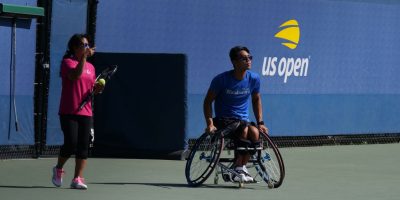
 Spotlight: Aki WolfsonJuly 30, 2026To celebrate 50 years of wheelchair tennis, we spoke with Aki Wolfson—one of the most prominent wheelchair tennis coaches in New York—about her life in the game. Read More
 -
 listens at a recent USTA Eastern board meeting.") Focus: Michael PavlidesMay 21, 2026USTA Eastern board member and longtime high school coach Mike Pavlides reflects on his life in tennis. Read More
Focus: Michael PavlidesMay 21, 2026USTA Eastern board member and longtime high school coach Mike Pavlides reflects on his life in tennis. Read More -
 NY/NJ Tennis ParticipationFebruary 26, 2026Tennis participation continues to boom across the Eastern section, with 2.6 million people (ages six and older) in New York and northern New Jersey picking up a racquet at least once in 2025. Read More

Sign up for our Newsletter
Download the USTA App

