Q&A: 2025 Wimbledon Finalist Ronit Karki
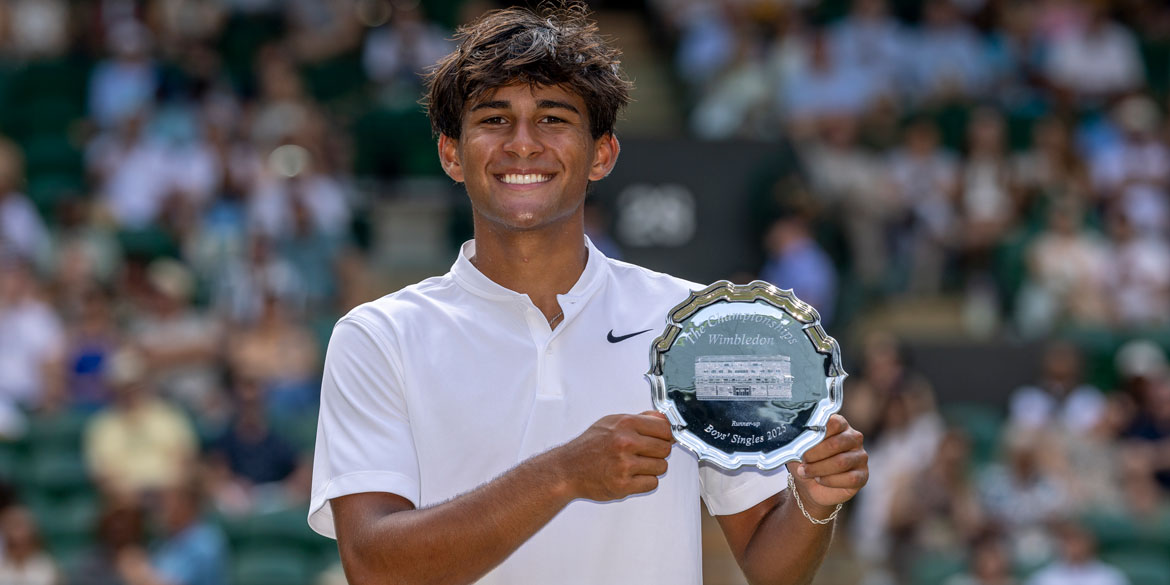 Ronit Karki lifts the runner-up trophy for the boys' singles final at the 2025 Wimbledon Championships. Credit: AELTC/Ian Walton
Another year, another Eastern junior putting on a show on the grass at the All England Club. Ronit Karki, of East Brunswick, N.J., entered the Wimbledon junior boys’ singles draw as a qualifier and defeated three seeded players in three straight matches to reach the final. (No. 6 seed Ivan Ivanov ultimately defeated the American, 6-2, 6-3, to lift the championship trophy.) Incredibly, Karki is the fourth player from the section—and more specifically, New Jersey—to contest a junior singles championship at Wimbledon in the last six years, following Summit’s Alexa Noel (in 2019), Basking Ridge’s Samir Banerjee (in 2021) and Montville’s Michael Zheng (in 2022).
Karki displayed some remarkable resilience throughout the fortnight. He overcame Switzerland’s Flynn Thomas in the first round in a 10-point, third-set tiebreak, then dropped the first set against the No. 8 seed Jack Kennedy (in an all-Eastern Round of 16 battle), the No. 14 seed Alan Wazny (in the quarterfinals) and the No. 12 seed Alexander Vasilev (in the semis) before finding a way to advance in three each time. We talked to Karki, 17, about his week of comebacks and his development as a player in the Garden State.
Reaching the final of a junior Grand Slam is a remarkable achievement! How are you feeling? Has it sunk in yet?
KARKI: Yeah, I’m super proud. If someone told me before this trip that I was going to go that far, I wouldn’t have thought it was impossible. But I wasn’t thinking ‘Yeah, this is going to happen’. That’s not the expectation. I’m just really proud to have achieved the result.
Your run was marked by several major comebacks, as well as some tough three-setters. Even in your final qualifying round bout you outlasted your opponent 10-6 in a match tiebreaker. What can you say about your resiliency throughout the tournament?
KARKI: One of the most important things was that I didn’t panic. I stayed calm in those situations, and I continued with the self-belief that I could pull through. From there I just got to work figuring out how I was going to win the match, what tactics I needed to adjust or what areas of my own game I needed to focus on.
Which of these battles en route to the final proved the most challenging in that regard?
KARKI: My quarterfinal match against Alan Wazny was probably the toughest. I broke him in the first game in the third, then quickly went down 1-4. I felt my energy level dropping and little tingles in my leg, almost like the onset of cramps. I just started trying to hydrate myself, eating things. My sister actually gave me a Kit Kat. [Laughs.] I felt like I couldn’t give my full effort down 1-4, but I knew I still had to play at a high enough level to [keep the score close] in the match. I found a way to manage being tired and still giving myself a chance to win. It ended up paying off because I felt like I had my energy back at 5-4.
 Ronit Karki slides after playing a backhand during his match against Ivan Ivanov in the boys' singles final on No. 1 Court at The Championships 2025. Credit: AELTC/Ian Walton
Juniors don’t typically play a ton on grass courts beyond this swing each year. What adjustments did you make to play on the surface leading into the event?
KARKI: My coach, Jay Gooding, has some experience going through this part of the season with players. He told me the one mistake a lot of players make transitioning to the surface is trying to change too much about their player identity. You obviously have to adjust to the pace of the surface and how the ball’s bouncing. But there wasn't too much about my own game that I really shifted, besides being ready for a fast ball to skate a bit and using some more slices, including on my serve, since that takes advantage of how the court plays. But in general, I would say there wasn't too much prep for any junior for this event. I was invited up to Tampa to practice on a grass court there, and I was grateful for [the opportunity]. It was good to work on footwork, but it’s hard to find Wimbledon-quality grass anywhere else in the world. So I embraced the fact that all juniors are not grass specialists, and that it’s a new experience for all of us.
How did you feel about your game once you started playing matches at [tune-up event] Roehampton and the All England Club?
KARKI: Jay actually told me he thought my game would transition well. I’m a shorter guy and the ball didn’t end up getting too low on me on the grass. I also like to play quickly, and the grass can reward you if you execute and take time away. I grew up playing on fast, indoor hardcourts, so playing on fast courts isn’t necessarily something I struggle with.
This is just the third junior Grand Slam you’ve played. What’s your overall takeaway from this result?
KARKI: I proved to myself that I can play at a high level consistently. And also just looking at the way I competed on court, I was able to figure out problems even when I went down in the score.
You’re the fourth player from New Jersey in six years to reach a Wimbledon junior final. What’s the connection between this event and the Garden State?
KARKI: I think in general there’s just a lot of talent in the northeast. It’s not the best weather for tennis. You have six months outdoors, six months indoors. But I think you learn how to adjust to different surfaces. And like I mentioned before, growing up playing on indoor hard courts is definitely helpful transitioning to grass.
How did you get started playing? When did you first pick up a racquet?
KARKI: My dad and my sister both played, and I would always watch them and want to get involved too. So as soon as I was old enough my parents enrolled me in lessons. For a while I just followed in the footsteps of my sister, trying to compete with her and beat her in practice.
You’re based down in Florida right now, but who were the coaches from New Jersey that helped you develop your game as you were growing up?
KARKI: Joao Pinho, who was based out of the Nassau Tennis Club, was really important in terms of developing my game. We had a lot of sessions just getting the technical side of my game down, as well as raising my intensity on court. He really had an eye for finding ways for me to improve, and I still work with him whenever I can when I’m back in New Jersey. And then I worked with Michael Sroczynski from ages 11-15 at Garden State Tennis Academy. He was super important, because when I first started working with him, I didn’t have big weapons. He really helped make my forehand a big weapon in my game. He’s also like a six-foot-six guy and I remember hundreds of lessons struggling to return his serve. Now I think my returning is a pretty strong part of my game, so he helped develop that as well.
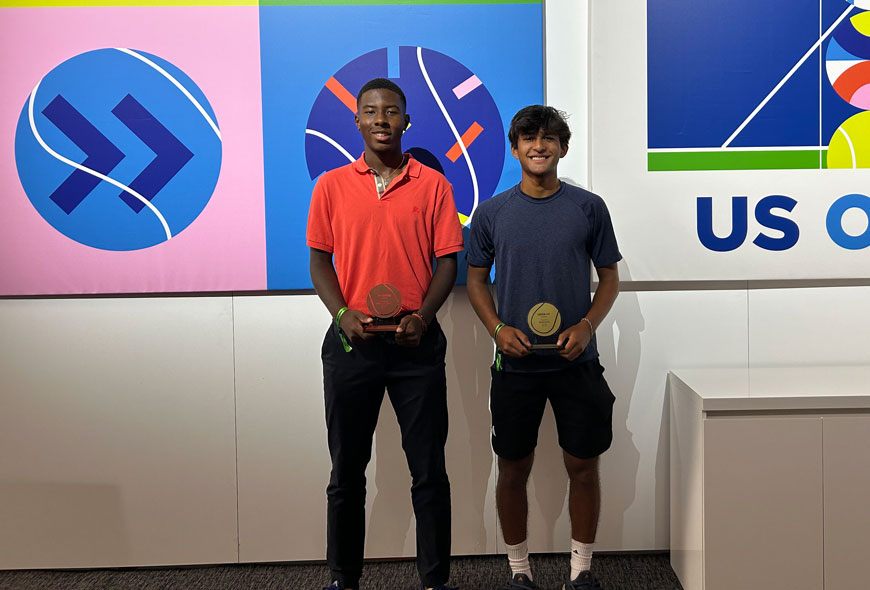 Karki (right) attends the 2024 Eastern Junior Awards Gala at the US Open.
Getting to this level involves a great deal of support. How has your family helped you on your journey in the sport?
KARKI: I’m just really grateful. My parents have always instilled certain values in me like being calm on court, competing with class and being respectful to my opponents. I’m always trying to improve that part of my game, and they’re the reason I take that part very seriously. My sister has also been a huge inspiration to me growing up. I have to thank my family for standing by me throughout all of this and being so supportive of me. Without them I wouldn’t be in this position.
What’s your advice to young juniors in the section hoping to get to your position one day?
KARKI: I think you have to find a way to love the sport and love the feeling of going in and training. Working hard is super important, but you really have to love putting the effort in. If you love the feeling of stepping on court and working on your game, even working through those days where it might not feel so good, training isn’t going to be a chore. And that just makes success more likely.
Related Articles
-
 League Sectional ResultsSeptember 28, 20262026 USTA Eastern League Sectional Championships are in full swing! Throughout the summer, USTA Eastern League teams from all of Eastern’s six regions are competing for the chance to represent the section at the National Championships. Check this page for the latest results, photos and more. Read More
 -
 poses with two-time Grand Slam doubles champion Vania King at a recent Eastern Tennis Conference.") Focus: Lopa ZielinskiMay 07, 2026USTA Eastern board member Lopa Zielinski reflects on giving back to the tennis community. Read More
Focus: Lopa ZielinskiMay 07, 2026USTA Eastern board member Lopa Zielinski reflects on giving back to the tennis community. Read More -
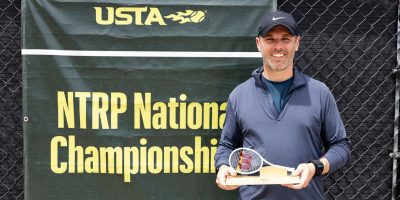
 Eastern at 2026 NTRPsApril 29, 2026Eastern players captured titles in five divisions at the 2026 NTRP National Championships, held April 10-12 (singles), April 17-19 (doubles) and April 24-26 (mixed doubles) in multiple locations across the country. Read More
Sign up for our Newsletter
Download the USTA App

