Ora Washington: Hall of Fame Inductee
Arguably the most accomplished tennis player in Philadelphia history is someone few tennis fans have ever heard of.
Ora Washington, from the Germantown neighborhood of Philadelphia, was a trailblazer for women, Black athletes, and so many more.
While the exact date of Washington’s birth is unknown, she was first listed on the Census in 1900, leading historians to believe she was born in 1898 or 1899 – Ora Washington, age 2, one of six children and daughter to James Thomas Washington and Laura Young Washington.
Around the age of 12, sometime in the 1910s, Washington followed in her Aunt Mattie’s footsteps, during what is referred to as The Great Migration, and boarded a train for Philadelphia (other family members would eventually make their way north as well).
Although Washington didn’t begin playing tennis or basketball until her early 20s, once she found the local Young Women’s Christian Association (YWCA) and her first coach Miss Rose Yancy, she became a dominant presence there and on both courts.

Washington’s groundstrokes have been described as “unorthodox,” holding the racquet above the grip and stabbing at the ball with a short poke, but despite not having the prettiest forehand and backhand, she had a powerful serve, overhead, and tremendous quickness. Within a year of picking up tennis, she entered her first national tournament for black players and won it.
Washington’s love of competition led her to 23 American Tennis Association (ATA) National Championships: eight singles, 12 doubles, and three mixed doubles titles. She held the ATA’s national crown from 1929-1936, often going years without a single loss to her record.
She was unable to truly show her talents at the time, as most white athletes refused to take the court against her. At the height of her talents, however, Washington was denied a match she longed to play against the top-ranked player from the United States Lawn and Tennis Association (USLTA, now the USTA), Helen Wills Moody. Washington reportedly challenged Wills Moody on multiple occasions, but the duo never faced off. Their match remains one of tennis' most alluring might-have-beens. It wasn’t until 1950 that tennis officially became desegregated when Althea Gibson played in the USLTA National Championships.
In 1988 Arthur Ashe wrote in The New York Times that it was unfortunate that most Americans hadn’t heard of Ora Washington, ” because Washington may have been the best female athlete ever.”
Washington not only paved the way for future tennis players, she did the same for the sport of basketball, dominating both sports simultaneously. As a member of the Germantown Hornets beginning in 1930 (winning the national championship that year) and later a member of the Philadelphia Tribune Girls basketball team (winning 11 consecutive Women's Colored Basketball World Championships), Washington was said to be one of the best players in the world.
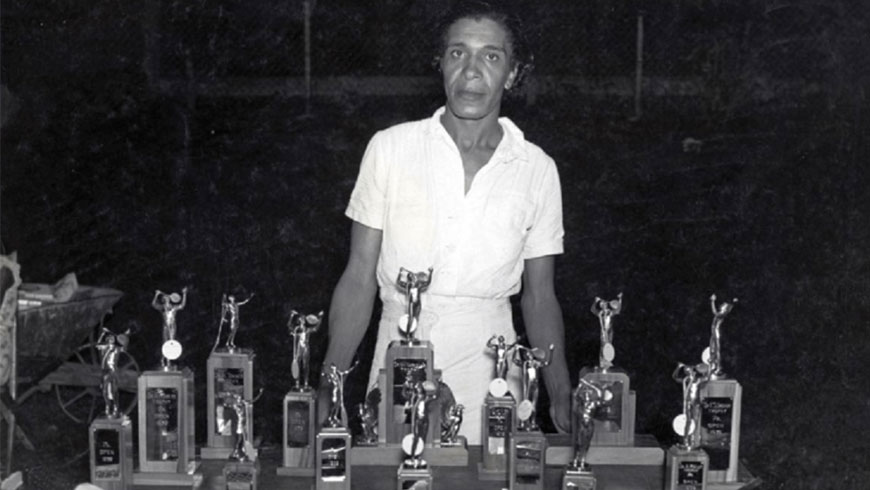


This distinction led to her induction into numerous Halls of Fame. Unfortunately, she passed away five years before her first recognition and induction into the Black Athletes Hall of Fame in 1976. Multiple inductions followed, such as Temple University’s Sports Hall of Fame in 1986, the Women’s Basketball Hall of Fame and the Black Tennis Hall of Fame in 2009, and the Naismith Memorial Basketball Hall of Fame in 2018.
In her very last interview with veteran Philadelphia Tribune reporter, Len Lear, he admitted that he had never heard of Washington prior to meeting her, but once he met her and asked her a lot of questions, he was floored. That final interview in 1969 took place where it all began for Washington, at the Germantown YWCA.
Lear went on to say this about his meeting Washington, "She was getting old and she was not in great health, but to learn that she was possibly the best female athlete in the country in the first half of the 20th century [and] she was doing housekeeping…It's just hard to imagine this today when you see people like Serena Williams, for example, making countless millions and having their name on perfume and all kinds of other products. And she had nothing. Nothing.”
"She did not express anger or rage specifically. She was more or less, I would say, sad. Over what could have been and should have been,” continued Lear. "She wanted to be recognised for her skills by everyone, and she wasn't."
Washington’s story continues to be told by historians, family members and fans of both tennis and basketball, shining light on her historical achievements and preserving her legacy.
Related Articles
-
![Visit the A Game Changer page]() A Game ChangerOctober 07, 2026For Dr. Jeff Robbins, tennis has been a constant throughout his life as a player, coach and author. Through his book Game Changers and his work bringing free tennis programming to Lebanon, Robbins continues to give back to the sport he loves. Read More
A Game ChangerOctober 07, 2026For Dr. Jeff Robbins, tennis has been a constant throughout his life as a player, coach and author. Through his book Game Changers and his work bringing free tennis programming to Lebanon, Robbins continues to give back to the sport he loves. Read More -
![Visit the Jade's Story page]() Jade's StoryOctober 05, 2026Jade Flores’ story began with Tennis Central at age 6 and has grown into a journey filled with tennis, hard work and memorable opportunities along the way. Read More
Jade's StoryOctober 05, 2026Jade Flores’ story began with Tennis Central at age 6 and has grown into a journey filled with tennis, hard work and memorable opportunities along the way. Read More -
 Creating CommunityAugust 25, 2026Kyle Hejmowski founded a free tennis club at Archangel Gabriel Catholic School, in Mckees Rocks, Pa. The program gives students in first through fifth grade a chance to learn the game in an accessible, low-pressure setting. Read More


Sign up for our Newsletter
Download the USTA App

