Six ways to help blaze a trail for women in coaching
Let's start by stating the obvious: There is a shortage of female coaches in tennis, and in the athletic industry at large. In order to help people understand where the disparity stems from and how to fix it, the USTA, its DEI team, and the women’s business resource group GameChangHERs recently held a virtual panel discussion aimed at finding solutions to the dearth of women in coaching.
The event, “Blazing a trail for women in coaching,” was moderated by Toni Wiley, the CEO of Sportsmen’s Tennis & Enrichment Center and the chair of the USTA National DE&I Committee. Three female coaches sat on the panel: Vanessa Fuchs, the CEO of WeCOACH; Milagros Sequera Huss, a former professional tennis player and the senior manager of adult programs and special projects at USTA Southern, and Lois Arterberry, the head women’s tennis coach at the University of Minnesota.
Here are the top six takeaways from their conversation, and how players, providers and current coaches can break down barriers and biases to empower the next generation of female coaches who are the norm rather than the exception.
Reach out and put in the effort to find strong candidates.
In order to hire a great coach, you will likely need to do some outeach as you search for the best possible candidates. Just posting a job and sharing it on LinkedIn and other job sites does not guarantee the applicants you’re looking for, and diverse candidates may not see the posting and apply—or think it’s the right position for them.
Even if you get great applicants, maybe a woman doesn’t apply or other candidates who fit the profile you’re looking for. However, that doesn’t mean that fantastic people who would be perfect for the role don’t exist.
“If we're going to really move the numbers to build a diverse pipeline, and then as far as sport leaders, hiring managers, I believe you've really got to be intentional and strategic,” Fuchs said. “If you've got a position that you're hiring for, you can't just post the job and hope women, people of color are going to apply. It just doesn't work that way. And so you really have to go out and be active and intentional in your outreach to build that diverse, qualified pool.”
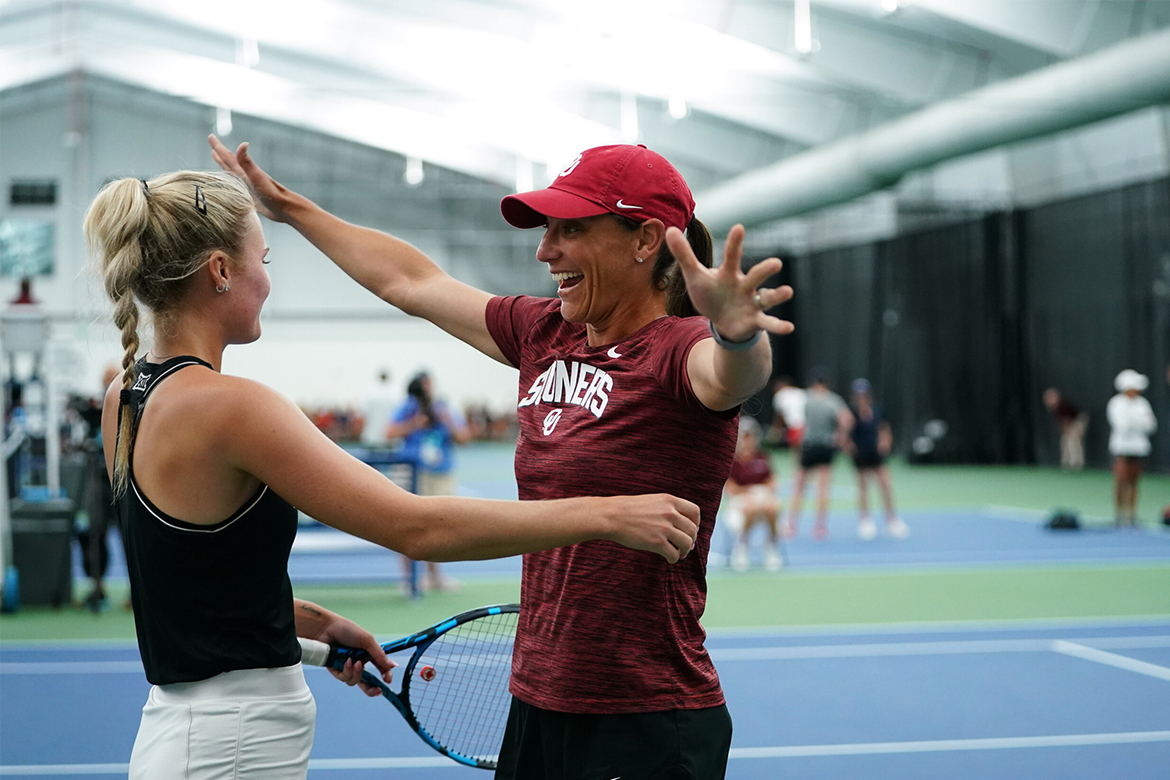 Layne Sleeth of the University of Oklahoma celebrates with her coaches during the 2023 NCAA Division I Women's Tennis Championships. Photo by Manuela Davies/USTA.
You need to be proactive to find the best candidates. When top professional teams or collegiate teams are finding new coaches, they often go out of their way to recruit by calling potential candidates—they don’t hope that top talent submits their resume.
Adopt the same mentality and utilize the resources available to you, from asking your personal and professional networks for names of people who could be a great fit to reaching out to leaders in the industry, such as USTA sections, WeCoach or other programs you admire for recommendations.
 A coach speaks to several players at the 2019 college combine. Photo by Manuela Davies/USTA.
Ask coaches what they need to be successful…
“The data says women are dropping out of coaching most often because of the lack of support they feel and the lack of equal pay,” Fuchs said.
“Once you make that great hire, support them, give them the pay that they deserve and continue that model and that support throughout their tenure as your coach.”
It might seem simple, but asking a few questions during a one-on-one meeting or in informal conversations can shed light on what staff members need to be successful in their current roles and develop their skills for the next position. While these conversations aren’t necessarily at the forefront of a busy head coach’s or provider’s mind, listening to coaches’ concerns can help with retention.
Each person’s situation is different—one coach may ask for a flexible schedule to accommodate eldercare needs or request the ability to bring their children to practices and matches if they have a demanding coaching schedule. Someone else might want additional training that could help them advance their career. Asking about your staff’s unique needs and goals can go a long way toward retaining and increasing the number of female coaches.
“We know with the right support and leadership, they can thrive as a really successful coach,” Fuchs said. “They may be in a certain role that might be entry-level initially, but how are we giving them the tools, the skills, the knowledge, the confidence to go after what's next?”
…And coaches should tell providers what problems they are facing.
While a lot of responsibility does rest with providers and managers, self-advocacy can be crucial in order for coaches to receive the support and solutions they need to thrive.
Are you looking to become a high-performance or collegiate coach but don’t know what steps to take or don’t have the resources available to do so? Do you need to figure out a way to balance being a great coach and a great parent? Tell your provider about your goals and concerns, and ask about possible remedies, or suggest some yourself.
It can be intimidating to ask your employer for help or let them know that you’re having a hard time with something, but as Sequera Huss said during the panel, oftentimes people don’t know what they don’t know.
 Melissa Schaub, head coach of the Ohio State University women's tennis team smiles with one of her athletes. Photo by Manuela Davies/USTA.
“Sometimes we assume that people know everything about us, but they don't really until you actually tell [them] and ask for help.”
Fuchs agreed, advising coaches to “ask your leadership what you need to do in order to take the next step [and] to advance your career, because sometimes there's not a lot of clarity around what you need to do to advance or get the next opportunity that comes available. So make sure you're really clear about that, and then work towards those things based on the feedback that you receive.”
 Net Generation kids participate in the Play Tennis Cincinnati clinic at the 2019 Western & Southern Open. Photo by Daniel Shirey/USTA
Find mentors to support you, and mentees to whom you can pay it forward.
Building a network that you can rely on and give back to is crucial for everyone, but especially for women trying to break into a male-dominated industry. Whether you want to ask for advice or just want to share your opinions and successes in coaching, having a community of people who you can rely on is important for your professional development and personal wellbeing.
By networking and finding advocates, you are opening up doors to opportunities that you’re interested in. During the ITA convention, Arterberry spoke up during a session, and gained an advocate who promised that if a job opened up that she was interested in, she would make a call on her behalf. When the position opened up at the University of Minnesota, her mentor stayed true to her word and helped Arterberry land the job.
However, mentors can show up in other ways, from answering questions about next steps to giving advice about tough positions that you might be in as a coach. Arterberry said that one of the best things for aspiring coaches to do is find a mentor who will support you.
“You have to have mentors around you. You have to have people that you know would support you and can help you navigate the path. It's not easy, at least my experience was not easy, but I persevered,” she said. “Just having people around you that reassure you that every time you feel like that, you're [almost] to a breakthrough, so you got to hold on.”
But once you’ve started to hit your stride, don’t forget to give back to the next generation. If you’re in a position to connect other women with potential opportunities or help them chart a course, make the effort to do so. If you think one of your students would make a great coach, let them know and help them navigate the world of coaching.
Remember that women are your teammates, friends and advocates—not your competitors.
In sports, we get used to wanting to be the best and beat the best. For female athletes, our fellow women are typically our on-court competitors. However, women are our teammates and supporters off the court.
If Sequera Huss could go back and give her five-year-old self advice about working in sports, she said she would tell herself exactly that.
“Women around you are your allies, they're not your competition. I grew up competing against women since I was five years old, so all my life I saw women as competitors, never as an ally,” she said. “Yes, we're competitors on-court, but off-court we have to stick together to make a bigger impact on the women's sports industry as a whole.”
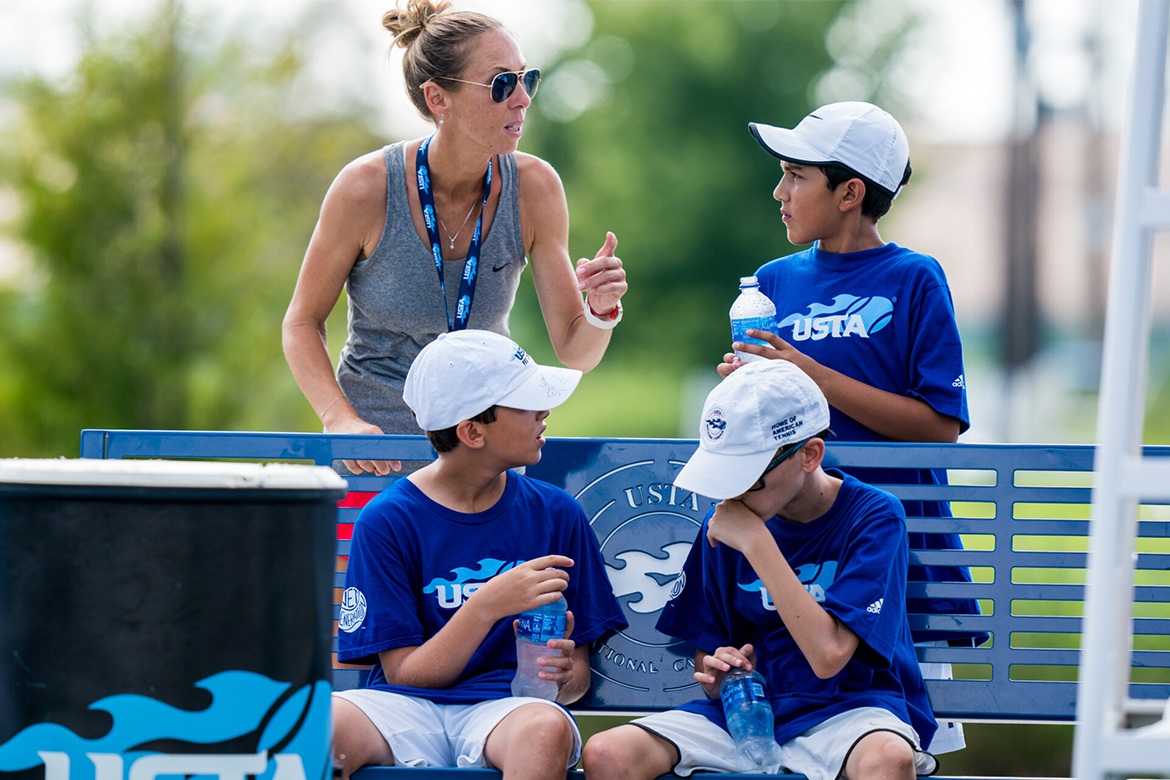 A coach in action. Photo by Manuela Davies/USTA.
Give women opportunities to coach all levels and athletes of all genders.
Too often, women are limited to coaching young children, beginners and other girls and women. While representation is crucial for the next generation to internalize that they can be coaches, too, women should not face restrictions in who they coach.
According to Wiley, a large part of the reason that many female coaches can’t make a living as a coach are the limitations placed upon them because of their gender.
“When we see female coaches, we often think of developmental tennis. We think red, orange, green. We think five-and-under, they'll be so good with the young kids,” Wiley said. “And then we don't give them access to either the adult or the high performance tennis that might lead to more hours and better compensation.”
 Emma Navarro and Lindsay Davenport during the 2024 Billie Jean King Cup by Gainbridge Qualifying. Photo by Mike Lawrence/USTA.
Additionally, female coaches are not inherently less capable of coaching men and getting great results—and they can thrive when given the chance. As Arterberry said on the panel, women are often underestimated when they coach men, but no one thinks twice about a man’s ability to coach women.
Arterberry was the head coach of both the men’s and women’s tennis teams at Jackson State University at just 25 years old, and was the youngest head coach and only female head coach. Under her leadership, the men’s team won their first championship in 18 years.
Sequera Huss believes that children should be taught this early on in order to understand that a coach can be successful and help them reach their full potential, regardless of their gender.
“I need my daughter to see a female coach. I want my son to be coached by a female coach,” she said. “I want them to see women in those positions because once you see it, then you understand and you start educating the other generations as to say, ‘Okay, I can be a woman coach, someone else can be a woman coach, I can be coached by a woman regardless of my level.’”
Related Articles
-
 USTA x SO first serveOctober 24, 2026After singles play at the 2026 USTA IDD National Championships, members of the USTA and Special Olympics kick off their multi-year commitment with ceremonial first serve. Read More
 -
 2026 Champs of EqualityOctober 20, 2026Kaitlin Roselius, Marcy Hirshberg and Kathy Connelly were recognized at the 2026 US Open during the fourth annual Champions of Equality event. Read More
 -
 2026 Award WinnersOctober 19, 2026From standout individuals to organizations and facilities, USTA Missouri Valley will celebrate the people and places making a difference at its annual awards ceremony. Read More



Sign up for our Newsletter
Download the USTA App

