Don't Lose Your Hat (Or the Point!): Understanding the On-Court Hindrance Rule
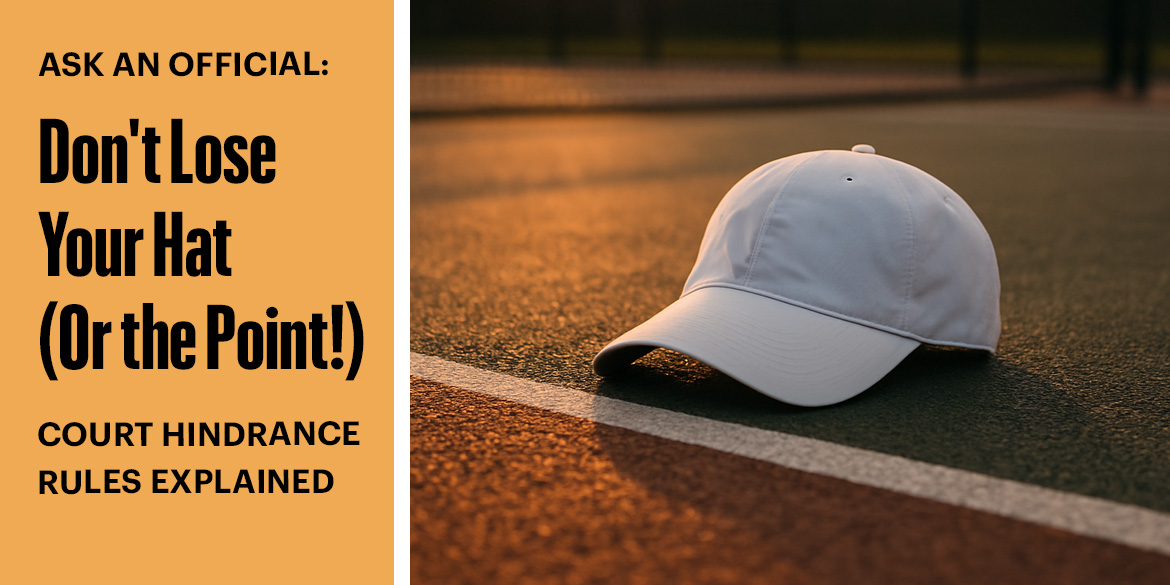
As you know, Texas tennis courts can be windy. What happens when your hat blows off during a match?
Most officials call this “The Hat Rule.” You will not find “The Hat Rule” in the Friend at Court, however, it does contain rules that address anything that a player has control of that may fall from their person and create a hindrance. A hat falling to the court is the most common example, followed by a ball falling out of a pocket. It could be anything the player has control of, for example, a hat, a towel in the waistband, jewelry, a ball falling out of the pocket, etc. But here, we will use the example of a hat to explain the rule.
If a player’s hat falls off during a point, an opponent may immediately stop play and call a let due to an unintentional hindrance. The player should be advised that any further hat or any article attached or on their person, falling into the court, the player will lose the point. This will be an intentional hindrance.
If the opponent does not stop play and does not call a let, the hat (or article) becomes part of the court, and play continues.
Here’s an example of how this can happen in a match: It is very windy, and on the third point of the second game. Player A is back at the back screen to hit a high topspin lob. Player A’s hat blows off and lands at the base of the back screen. Player B chooses not to stop play and does not call a let. In this example, there is no hindrance. (No one was endangered by the hat at the back fence.) Good call, play continues.
In the second point of the third game, Player A runs up for a drop shot. His hat falls off in the middle of the court (An object in the middle of the court could create a hazard to the player). Player B immediately stops play and calls a let. The first time the let is called for this, it is an unintentional hindrance. Player A is advised that if anything falls that he has control of it may cause a hindrance and he will lose the point. Player A fixes his hat. The point is replayed.
In the second set, during the point, a ball falls out of Player A’s pocket. It is under Player A’s feet, creating a hazard, and Player B stops play and calls a let. At this point, this is now considered an intentional hindrance, and Player A loses the point.
In the fifth game of the second set, Player B’s watchband breaks, and the watch falls to the center of the court, creating a hazard. Player A stops play and calls a let. Because this is the first time Player B has caused a hindrance, it is considered unintentional, and the point is replayed. Now both players know if anything falls to the court and play is stopped, someone is losing the point.
The Code, FAC page 41
33. Claiming a hindrance. A player who claims a hindrance must stop play as soon as possible.
The Code. FAC page 42
A let is never authorized for a hindrance caused by something within a player’s control, such as when a player’s racket comes out of a hand, when a player’s shoe comes off, or when a player trips over the player’s own hat. However, if a player’s hat falls off during a point, an opponent may immediately call a let due to unintentional hindrance. The first occurrence is considered an unintentional hindrance. Any further items that fall to the court from that same player are considered an intentional hindrance, and the player loses the point.
FAC page 13, 26. HINDRANCE If a player is hindered in playing the point by a deliberate act of the opponent(s), the player shall win the point. However, the point shall be replayed if a player is hindered in playing the point by either an unintentional act of the opponent(s), or something outside the player’s own control (not including a permanent fixture).
 Terry Gatzki, USTA Texas Official
Related Articles
-
 2026 Combo SectionalsOctober 20, 2026Combo League teams from across Texas met in Corpus Christi to determine the 2026 section championship title. Read More
 -
 HHM: Sebastian SainzOctober 13, 2026For Sebastian Sainz, Hispanic Heritage Month is more than an annual celebration, it is a daily commitment to representation, community, and honoring the roots that shaped him. Read More
 -
 Wheelchair 50: TexasOctober 09, 2026Celebrating 50 years of wheelchair tennis, USTA Texas is expanding access, building school programs, and driving inclusive opportunities across the state. Discover how Texas is shaping the future of adapted tennis. Read More



Sign up for our Newsletter
Download the USTA App

