The science behind how adaptive tennis can benefit players with intellectual and developmental disabilities
A recent study shared by the Mayo Clinic showed that tennis players, on average, can live nearly 10 years longer than those who live a sedentary lifestyle. And that’s just the tip of the iceberg when it comes to how the sport can improve one’s health, with the social and emotional benefits just as important as the physical effects.
But these life-changing benefits are particularly impactful for individuals with intellectual and developmental disabilities, says Dr. Rujuta Wilson, a lifelong tennis player and a pediatric neurologist at the UCLA David Geffen School of Medicine, with a focus on autism spectrum disorders and other IDDs. Wilson studies differences in motor development in individuals with IDDs and how this can impact their physical, developmental, and behavioral well-being. She says that tennis may particularly hold many keys to fostering a healthy lifestyle in a portion of the population that has, for one reason or another, historically not had its health and wellness needs met.
Here are some of the reasons why.
Historically, there have been barriers for neurodivergent people in organized physical activity.
Regular physical activity can positively impact children in many ways—from stronger bones and muscles and lower levels of body fat, to improved cognition and reduced anxiety. But neurodivergent children are, oftentimes, not having the same development experience: A nationwide study once said that individuals with IDDs are 4.5 times less likely to engage in physical activity compared to neurotypical children, while other reports have shown that only 15% of children with autism meet the recommended 60 minutes of physical activity a day.
With her specialty being in pediatric neurology, Wilson says that there are many reasons for this, but chief among them is a simple truth: They simply move, learn and grow differently.
But tennis is a sport that can easily be adapted to suit their needs.
Tennis, Wilson says, is “a model sport” for everybody—for the reasons already stated—but one that also makes sense for neurodivergent people.
 A recent adaptive tennis clinic at UCLA. Photo courtesy of Dr. Rujuta Wilson.
By consisting of “pieces” that, together, help a player achieve success—from learning how to properly hold the racquet and lifting their arm to volley, to shuffling their feet to get in position and coming to the net—these players own a level of autonomy over positive on-court milestones, even before they hit a ball.
The repetitive nature of tennis helps to reinforce their learning, too. It builds on important concepts of fundamental movement skills that can be particularly beneficial to individuals with IDDs, as Wilson’s research has shown that they often have movement challenges and differences.
“They can start learning these skills and building on these skills just within themselves, with a coach or with one other individual,” she said. “Success is not dependent on five other people doing various things like basketball might be or soccer might be."
 Dr. Rujuta Wilson.
Some of tennis’ chief skills—hand-eye coordination, visualization and overall concentration—are things that neurodivergent individuals may struggle with. But Wilson says that this is not a hindrance to their participation; in fact, it’s the opposite.
“You can break down those tasks really nicely for an individual, point by point, piece by piece, to slowly build up for them to be at a point where they're successful at putting all the pieces together,” she said. “When you do that, you're also working on other areas to build up different aspects of the individual, not just physical activity and motor skills, but some of these other areas that are really fundamentally important for them to learn and to gain things from.”
Coaches are the first step to fostering access to tennis.
The adaptive tennis community is thriving thanks to its passionate base of coaches and volunteers—in the U.S., for example, there are already hundreds of USTA-certified adaptive tennis programs serving kids and adults nationwide—all of whom are committed to fostering a lifelong love of tennis in the community.
But the sport still has much more room to grow, and there are many ways for coaches and other providers who are interested in supporting individuals with IDDs to do that, Wilson says. She has a message to coaches who might be wanting to get involved in the adaptive tennis space, but just might not know where to start.
“I would tell them that the work that they're doing to know has very broad benefits across many important aspects of life,” she said. “When I've empowered or spoken to coaches about that, it has really struck a very positive note to say, 'Wow, the sort of work that we're doing, it's not just about getting them physically active, but it really can improve so many other aspects of their life social engagement, attention, executive function, mood, improvements in anxiety and depression.' But the other thing I would tell these coaches is that … meeting these kids at their level is also crucial.
“Sometimes, I think even as a clinician, we think that individuals with neurodevelopmental disabilities, particularly kids, are not interested in these programs, they're not interested in participating, and that's why you sort of say, ‘OK, well, you know, we tried and we tried to get them on the court, but they really just weren't interested.’ But the reality is that many of them are very interested. Some of the reasons why they haven't participated is because they've never maybe been given the opportunity, they've never been exposed to this activity.
“We often talk in the research side, we try to measure ability and we say, ‘Oh, they can't do this.’ But the reality is, have they ever been given the opportunity to actually practice this skill the way maybe another child has? So maybe it's not that they can't hit the ball, they've just never been shown how to hit a ball. I think interest has varying levels, so that's important to know that maybe it's the confidence of the child, and the family, that's keeping them from really fully engaging.”
And the resources to help coaches do this already exist.
The USTA’s national adaptive tennis committee has authored a Level 1 adaptive tennis manual, designed for teaching the sport to first-time players with cognitive disabilities—and it can be utilized for players of all ages. But in addition to just embracing a different, or unfamiliar, method of on-court instruction, she says, coaches also might have to adapt how they see themselves—particularly in the way in which they define success.
“For coaches, their success is very much measured by the success of their players, which I think is wonderful and important,” she said. “For some families and kids, just stepping on the court that day is a huge success, and that's OK if that's all they achieve, because you've already succeeded in enrolling this child in something that can enhance their daily activities, maybe that their sibling is doing, that they can now talk about; in giving them the confidence to know that they can get to a program, and that their child will get on the court.
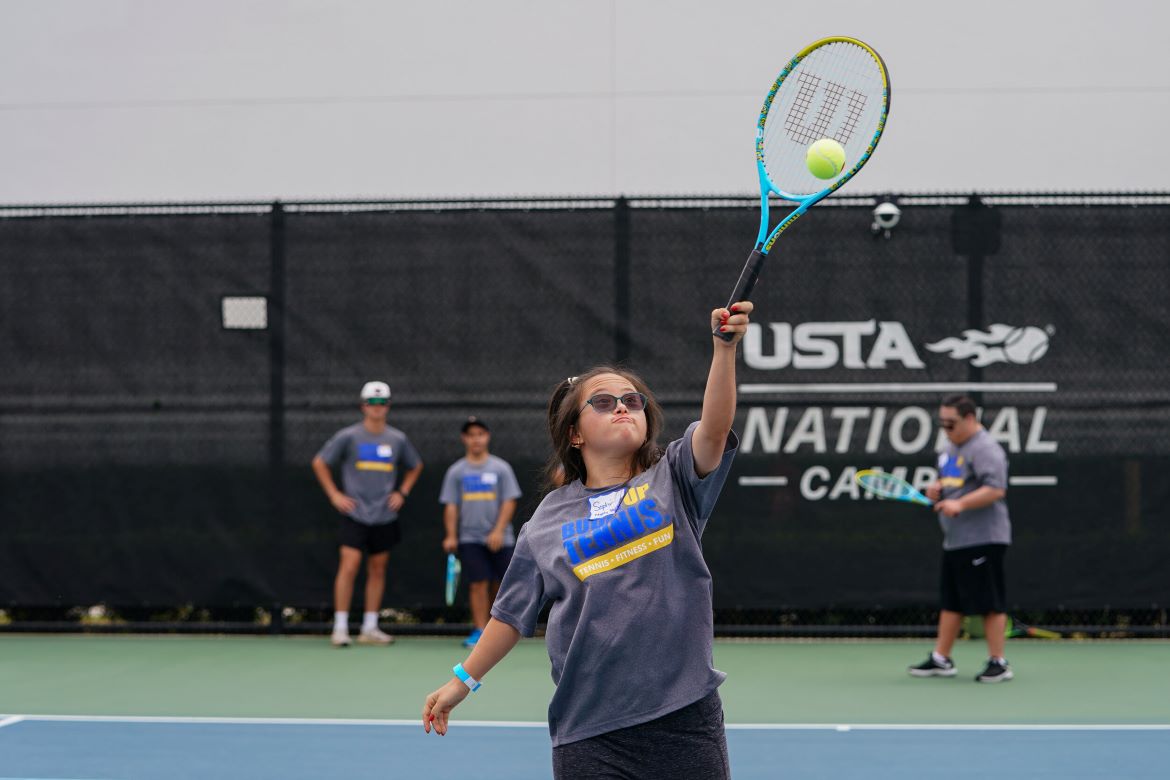 Photo by Manuela Davies/USTA.
“If they didn't hit the ball this entire hour-long session, it doesn't mean they have not succeeded or are not interested. It means that the next time we're going to see if they not only get on the court, but they actually hold the racquet, too. I think knowing that those things are so meaningful for some of these families, it's something I tell coaches so that they don't get discouraged when they enter this space and can have meaningful discussions with families about what this program means to them.
"I have witnessed first hand the tremendous positive impact tennis participation has on individuals with IDDs and their families to participate. It is clear that there is a great need to continue to grow and provide adapted tennis programming for all individuals to experience this wonderful sport."
For more information on adaptive tennis and how to get involved with a program near you, click here.
Related Articles
-
 2024 Adaptive NationalsOctober 11, 2024This year's national tournament saw 25 unified doubles teams—pairs comprised of an adaptive athlete and their non-disabled partner, called a unified partner—from 10 USTA sections compete. But the annual national tournament is not just an avenue to reward the best players, but showcase the rapidly-expanding adaptive tennis community. Read More
 -
 Teens changing the gameJuly 30, 2024Two Midwest teenagers—Annabelle Murphy, 17, and Sharla Plier, 15—who play alongside their able-bodied peers are a living example of the more inclusive era that's blooming in tennis. Read More
 -
 Para-Standing WorldsJuly 26, 2024Four Americans represented the U.S. with pride at the Para-Standing World Championships last month in Italy. This is their story. Read More


Sign up for our Newsletter
Download the USTA App

