Growing the Game in Lancaster

Not many people can say fly fishing is the reason they got into tennis. But Lancaster, N.Y.’s longtime supervisor of tennis instruction George Besch can.
“I had just moved back to western New York at 44 years old, and I didn’t know anything about tennis,” Besch says. “I happened to be talking to a guy who coached the local high school team and worked as a pro at one of the clubs up here. He found out that I taught fly fishing, and he wanted to learn. And he obviously taught tennis, and I wanted to learn. So we bartered.”
The lessons proved to be quite consequential. Just two years removed from his entry into the game, Besch put his name in the hat when the town was looking for someone to lead their recreational tennis operation. Nearly four decades later he’s still running Lancaster’s programming—and building a robust community in the sport in the process.
“When I took the job, the town had one assistant for me and two hoppers of regulation balls,” he says. “Now I've got a staff of 13 and three car loads of different kinds of tennis balls.”
Indeed, Besch’s varied playing opportunities regularly attract more than 200 residents (and non-residents) to the courts each summer. During the day, he oversees camps for a variety of ages and ability levels, welcoming juniors as young as two through the town’s “munchkin” program all the way up to more advanced players who compete on their varsity tennis teams. In the evenings, entire families come out to try the sport and partake in a little formalized instruction.
Over the years, he’s also built a teaching pipeline in Lancaster; many of Besch’s instructors are high school seniors and college students who started off as “munchkin” participants in the town's programming when they were three or four years old. Besch enjoys elevating his former campers and training them for these roles. For one, they are already pretty familiar with the games and drills that Besch likes to employ. And for another, they have a keen understanding of Besch’s overall mission: That everyone has fun.
“With the kids, we’re always inventing different, fun games,” Besch says. “We have water balloons that we use for the hot days. If they answer a question correctly or win one of our games, we give them a ticket [that they can redeem] for prizes at the end-of-the-season picnic. And with adults, I tell my staff, ‘Treat them like nine-year-olds.’ Make them run, make them sweat! I used to go around saying, ‘I hope this isn’t too much.’ And people would laugh and say it was just what they needed. Adults like to be treated like any other person who’s learning. They consider that fun.”
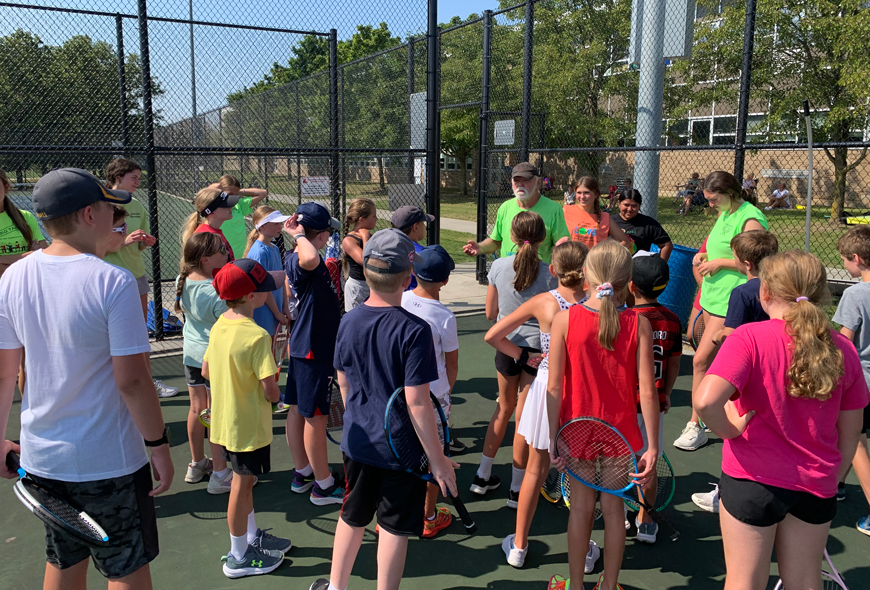 Lancaster Supervisor of Tennis Instruction George Besch talks to participants at a "foam ball" event for juniors.
Another fun offering for adults is the town’s doubles tournament. Players switch partners every four games in a round robin format, and proceeds benefit a variety of different causes, like hospice and palliative care and local food kitchens. Besch—whose other major passion outside of the sport is social justice advocacy—was inspired in developing the event by the local restaurant Big, Big Table, which employs a “pay what you can” model to help address food insecurity. Likewise, participants in the Lancaster doubles tournament pay what they can afford for the competition's entry fee.
“It’s really an easygoing tournament,” Besch says. “You get to meet five different players, and it’s for charity. It’s a party!”
These kinds of events are what inspired Besch to take on this role in the first place. He believes wholeheartedly that municipalities have a responsibility to offer fun, affordable recreational opportunities to their residents. (For the first 15 years he ran programming, he insisted that his offerings be free for kids.) He even keeps a trove of demo racquets so that potential participants can come to the court and take the sport out for a spin before fully investing in their own stick.
Given his own background in the game, he’s always understood how picking up the sport—at any age—can change lives. But after decades of coaching, he’s frequently reminded of just how deep that impact can go. And that’s what has continued to call him out to the tennis courts every day 40 years later.
“After doing this for a little while, people started stopping me in the street or at the coffee shop or somewhere else in town,” he says. “They’ll say, ‘I don’t know if you remember me, but you taught my son or my daughter.’ And their kid may not still be in tennis, but they’ll tell me that they learned so much about having strong values, about being a part of a team, about having ethics, respecting other people and making honest calls. I realized that there’s a lot going on in teaching tennis besides teaching forehands and backhands. And hopefully coaches in other sports are doing this as well! But there’s certainly ample opportunity to teach those kinds of things in tennis.”
USTA Eastern is proud to support Besch's program through the Growing Tennis Together grant. Contact Parks & Recreation Coordinator Kelsey Altavilla to learn more about how USTA Eastern can support tennis programming in your local park.
Related Articles
-
 League Sectional ResultsSeptember 28, 20262026 USTA Eastern League Sectional Championships are in full swing! Throughout the summer, USTA Eastern League teams from all of Eastern’s six regions are competing for the chance to represent the section at the National Championships. Check this page for the latest results, photos and more. Read More
 -
 lifts the runner-up trophy for the boys' singles final at the 2026 French Open. Photo Credit: Julien Crosnier/FFT") Q&A: Michael AntoniusJune 22, 2026Michael Antonius, of Buffalo, N.Y., reached the 2026 French Open boys' singles final without dropping a set. We talked to Antonius about his big week in Paris. Read More
Q&A: Michael AntoniusJune 22, 2026Michael Antonius, of Buffalo, N.Y., reached the 2026 French Open boys' singles final without dropping a set. We talked to Antonius about his big week in Paris. Read More -
 Reeling in Tennis LoveJuly 15, 2025Fly fishing, of all things, brought George Lesch into tennis. Four decades later, the Lancaster, N.Y. official has built a vibrant community in the sport. Read More
Sign up for our Newsletter
Download the USTA App

