Beyond the Baseline
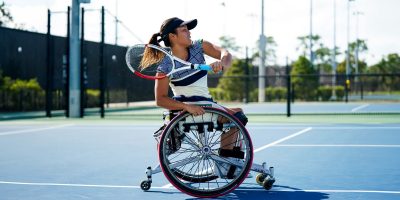
As we celebrate the 50th anniversary of wheelchair tennis, we look toward tennis leaders who are growing the game across the country. Our Beyond the Baseline series will introduce you to players, coaches and organizers whose lives have been impacted by wheelchair tennis—and how they plan to move tennis forward to positively affect the newest generations.

Valerie Wallace has always been an athlete. After losing her leg in a car accident in 1981, she continued to pursue sports and was encouraged by friends and fellow athletes, including Lee Montgomery, to try wheelchair tennis.
She first played in 1983 on an indoor grass/carpet tennis surface and quickly fell in love with the sport. LuAnne Westonbrook became an early supporter, helping Wallace afford both a wheelchair and racquet so she could compete. Wallace joined a Michigan wheelchair tennis team as its only female player.
Soon after, she traveled to Irvine, Calif., where she met Brad Parks, the inventor of wheelchair tennis. A few years later, the Michigan team competed at the California Wheelchair Tennis Open and swept every division. Wallace personally captured both the singles and doubles titles.
In 1987, Wallace competed in front of the International Olympic Committee, helping wheelchair tennis become an official Paralympic sport beginning in 1988. She was also Michigan’s first female wheelchair tennis player and was named the 2025 recipient of the Bender Family Wheelchair Performance Award.
Wallace continues to play both wheelchair and able-bodied tennis. She currently competes as a 3.0 able-bodied player and a 4.0 wheelchair tennis player.
She coached high school tennis for 17 years and also coached middle school tennis for both able-bodied players and athletes with disabilities. Today, she focuses primarily on coaching junior wheelchair tennis players ages 10 and under and teaches para standing tennis.
Wallace has witnessed major changes in every area of the sport, including equipment, fitness, training and wheelchair design.
When she first began competing, tennis wheelchairs had only four wheels with minimal camber, and players were not strapped in securely, making falls common during play. Modern chairs now feature five-wheel designs, customized strapping systems and much greater stability, making them far safer and more performance-oriented.
She recalls a memorable match played in those earlier chairs, where both she and her opponent—a double amputee—fell out of their chairs during a long rally. Wallace still managed to get her racquet on the ball and hit a lob to win the point. Both players ended up lying on the court laughing afterward.
Wallace believes able-bodied coaches need to think creatively and truly understand wheelchair movement. She encourages coaches to get into a chair themselves to better understand mobility, positioning and player limitations.
“The wheels are their feet,” she explains. Coaches should study chair movement, watch instructional videos and maintain open communication with players, since every athlete’s physical abilities and limitations are different. She also strongly emphasizes teaching topspin as a key part of player development.
What advice would she give to players? Learn to move forward and attack the net. Wallace notes that many wheelchair players stay back because moving backward in a chair can be difficult, but she believes points can often be won at the net.
She also encourages players to communicate openly with coaches about their injuries or medical conditions so training can be tailored appropriately. Developing strong chair movement skills—both with and without hitting tennis balls—is another essential part of improvement.

Wallace would like to see more women involved in the sport. In earlier years, there were dedicated women’s divisions and tournaments, but declining participation has led many competitions to shift to combined-gender formats.
As a result, female players are often placed in broader divisions, which can make competition more difficult. Wallace hopes the sport can find ways to grow female participation and create more opportunities specifically for women athletes.
Wallace loves the challenge of the sport and the opportunity to continuously push herself as both a player and coach. She especially enjoys helping young athletes develop confidence, improve their movement and discover what they’re capable of on the court.

Paul Moran grew up loving sports, especially baseball, and was a devoted St. Louis Cardinals fan. An accomplished multisport athlete, he competed in four Paralympic Games as a volleyball player before eventually transitioning to wheelchair tennis.
His introduction to wheelchair tennis came through encouragement from fellow adaptive athletes, including Midwest wheelchair tennis player Lee Montgomery, who convinced him to come watch wheelchair tennis. Once Moran saw the sport firsthand, he was hooked. Glenn Alfred at Midtown Athletic Club became his first wheelchair tennis coach.
Paul Moran went on to compete at the highest levels of the sport, including representing the United States in wheelchair tennis at the 2000 Paralympic Games. During his competitive career, he achieved a world ranking inside the top 20. In addition to tennis, he still competes in wheelchair softball today.
Moran has seen wheelchair tennis evolve dramatically in every aspect. Equipment has improved significantly, with lighter, more advanced wheelchairs and racquets contributing to a faster, higher-quality game.
Training methods and player development have also progressed, helping elevate the overall level of competition in wheelchair tennis.
As a coach, Moran enjoys watching players learn, improve and experience success. Seeing athletes figure things out and gain confidence through the sport is especially rewarding for him. He takes pride in sharing in their accomplishments and growth.
As a player, he still loves the excitement of going for “big shots” and the thrill that comes when they work exactly as planned.
He encourages players to "practice any way you can." Hit against a wall, use a ball machine, take lessons and spend time practicing independently. Developing muscle memory through repetition is essential.
He believes understanding how the wheelchair moves is critical to effectively coach the sport. By getting into a chair and experiencing the movement yourself, coaches can better understand player positioning, mobility and shot preparation.
He also emphasizes the importance of finding a community to play with. Wheelchair tennis is inclusive, allowing athletes to compete alongside both wheelchair and able-bodied players, which creates more opportunities to improve and enjoy the game.
Wheelchair tennis has allowed Moran to continue competing at a high level, connect with athletes across the country and around the world, and share his passion for sports through coaching.
He also credits many people in the Midwest wheelchair tennis community for helping grow the game over the years, including Lynn Bender, Melissa Downs Kress and Lee Montgomery, among others.

Sue Katerberg was introduced to wheelchair tennis in 1995 and has since made a tremendous impact as both a coach and an advocate.
She worked at a tennis club where she observed a group of wheelchair tennis players practicing and quickly recognized opportunities to adjust technique—particularly grip and hand positioning—to generate topspin and more power. She notes that executing a topspin backhand can depend on a player’s positioning in the chair, adding a unique technical dimension to the sport. After sharing her thoughts, players saw immediate improvement, sparking Katerberg's deeper involvement in the sport.
As the game has advanced technically, training has followed suit, with players experiencing growth not just in skills and physical abilities but also in mental confidence.
Katerberg has coached at the collegiate level and has consistently integrated wheelchair athletes into her broader tennis programming. She enjoys integrating able-bodied players, particularly younger athletes, into practices to become more engaged in the sport's inclusive nature and make connections through tennis.
She also appreciates the travel opportunities tennis can give players, but points out that travel can be more challenging for wheelchair athletes.
For Katerberg, the future of wheelchair tennis depends on continued access and opportunity. More court availability, structured programming and stronger integration with the broader tennis community can all contribute to growth, and increased funding and sponsorship can help players travel and compete.
For coaches, Katerberg says the key is to treat players as tennis players first and focus on fundamentals, especially proper stroke technique. She emphasizes that wheelchair tennis should be taught the same way as traditional tennis, with the only difference being that athletes are seated.

Lee Montgomery is a pioneer of wheelchair tennis who began his competitive career in 1980. He rose through the ranks to achieve a top-10 national ranking and earn multiple championship titles. Beyond on-court success, Lee has contributed to the development of early wheelchair tennis technology and remains a passionate advocate for greater accessibility and opportunities for future generations of players.
Lee Montgomery was introduced to wheelchair tennis by Luann Hagge at a wheelchair basketball game in Grand Rapids, Mich. She asked if anyone wanted to try tennis. Montgomery was interested and would go on to become one of the first Black wheelchair tennis players.
He began competing at an entry level in 1980 and quickly found success. In the same division, he won singles and doubles titles at the US Open, then steadily progressed through the ranks. By 1984, he was competing in the open division. That year, he played alongside Brad Parks, the founder of wheelchair tennis, to finish as runners-up and third in singles.
During his career, Lee trained by playing daily, often competing against able-bodied players to improve timing, movement and endurance. He supplemented this with some weight training, but today’s players benefit from structured training programs, personal coaches and more advanced conditioning.
Montgomery competed through 1993, when a rotator cuff injury forced his retirement. He finished his career ranked No. 10 nationally and in the top 20 internationally. During his playing days, there was no prize money—he competed purely for the love of the game and the spirit of competition. Montgomery has seen prize money improve significantly, but notes that the number of tournaments has decreased and that the costs of competing have risen. Montgomery hopes to see more financial support for players, especially younger athletes, to help cover the costs of travel and competition. He believes the sport's growth will depend on its visibility, accessibility and sustainability, which is why he advocates televised matches and a more equitable distribution of prize money across divisions to help offset expenses and encourage broader participation.
Lee Montgomery was personally involved in the early development of custom tennis wheelchairs through a sponsorship with a manufacturer, contributing feedback that helped shape design improvements. Wheelchairs are now lighter and more performance-driven, and racquets have become more technical and easier to handle. Playing surfaces have changed as well—clay courts are now more common at the elite level, something Montgomery did not encounter during his playing career. International competition has strengthened, and he's seen growth in youth participation.
If there's any advice he can give new players, it'd be to have fun with the game. Enjoyment is a key part of long-term success. For coaches, he recommends focusing on coaching the player rather than the wheelchair. Emphasize fundamentals and simplicity. Help players develop and rely on their strongest shot to build confidence and create opportunities during matches.

Julie Fritz is a former collegiate tennis player and graduate of Western Michigan University, where she studied special education for the physically impaired. Since then, she has become a dedicated coach and advocate, helping grow the game while fostering inclusive opportunities for athletes of all abilities. Fritz has witnessed the sport’s evolution firsthand and continues to champion greater accessibility, integration and visibility for wheelchair tennis.
Julie Fritz was introduced to wheelchair tennis at a clinic and became hooked immediately. Soon after, she met an athlete involved in wheelchair basketball, which sparked her interest in recruiting and coaching wheelchair tennis players. That moment set her on a path that combined her passions for tennis and working with individuals with disabilities.
Over the years, she has seen wheelchair tennis become significantly more competitive, and equipment has evolved dramatically. Players today train at a much higher level, and there’s been a greater emphasis on physical conditioning, skill development and specialized equipment—all of which have elevated the level of play.
Unchanging though is the inclusivity of the sport. Players often partner with someone who is able-bodied, and Fritz regularly integrates wheelchair athletes into traditional tennis drills.
When asked what advice she would give players, she said, "Don’t be intimidated. Stick with it. Wheelchair tennis is not easy to learn. It requires coordinating chair movement, racquet control and shot execution all at once. Learning any new skill takes time and persistence."
For coaches, she recommends getting in a chair and experiencing the sport firsthand. Fritz emphasizes the importance of understanding the game from the player’s perspective, focusing on teaching players how to make contact to build confidence and encouraging them to simply try.
Fritz remembers when she was in school, how adapted sports weren’t widely recognized. Now, she's found a passion for teaching wheelchair tennis. She hopes the sport continues to grow and increase in visibility. She wants the tennis community to create more opportunities for players to simply get on court. Increasing accessibility at tennis facilities is critical.
More broadly, she hopes to see less separation between “wheelchair tennis” and “tennis” and more integration, with a focus on the sport as a whole and creating inclusive opportunities for everyone.
Related Articles
-
 Oct. 2026 Tennis NewsOctober 05, 2026Catch up on October tennis in Northern Indiana, including Adult League and Junior Team Tennis updates, upcoming junior tournaments and district news. Read More
 -
![Visit the Beyond the Baseline page]() Beyond the BaselineSeptember 29, 2026As we celebrate 50 years of wheelchair tennis, this series highlights the players, coaches and leaders growing the game and inspiring future generations through the sport. Read More
Beyond the BaselineSeptember 29, 2026As we celebrate 50 years of wheelchair tennis, this series highlights the players, coaches and leaders growing the game and inspiring future generations through the sport. Read More -
![Visit the Adult League Results page]() Adult League ResultsSeptember 28, 2026Find your results for all USTA Midwest League Championships. Read More
Adult League ResultsSeptember 28, 2026Find your results for all USTA Midwest League Championships. Read More


Sign up for our Newsletter
Download the USTA App

