Technically Speaking: Ernie Katko builds better players from the ground up

Ernie Katko spent much of his adult life in or near the big cities of New York and Chicago. After moving to the Quad Cities five years ago, he’s enjoying the slower pace of LeClaire, Iowa. But don’t think for a second that he plans to slow down himself.
“It’s nice here,” said Katko, director of the high-performance program at Quad City Tennis Club, where he also runs all the club’s USTA events. “It’s a smaller area than I’m used to. It’s a little different atmosphere, but it’s nice. LeClaire is a great little town right on the Mississippi River. There’s a lot going on here, and a lot of tennis in the area, too.
“I’ve been working with the players here, trying to help them develop. We’ve had around 20 players from the Quad Cities area who ended up playing No. 1 singles for their high school teams.”
Katko moved to the area because his wife has family there. He spent the previous 30 years in New York City and the suburbs of Chicago, where he built his successful coaching career. Katko is a member of USTA Coaching.
“I did a lot of stuff with USTA Midwest,” he said. “I was the tennis director at an academy in the suburbs. We had a lot of top players going to the next level. I’ve had players who ended up playing at Stanford, Michigan and Indiana. Those are some pretty good schools out there.”
Katko played college tennis at West Liberty University, located in West Virginia about an hour southwest of Pittsburgh, Pa. He had a strong playing career, which prepared him to train tennis players for the Division I level.
So, is he a better coach than he was a player?
“I don’t want to say that myself,” he said. “But you could say that. That’s fair.”
What separates Katko from many in the field is his focus on the technical aspects of the game.
“The key is getting that technical base,” he said. “If someone is not superior athletically, which most are at the highest level, then I’ll focus the game on another structure where they’re able to take advantage.
“If they’re athletic, then you take advantage of that. It’s kind of like building a different game. If someone is 6 feet 5 inches, he’s going to take advantage of the serve as opposed to a different-sized player.”
With his decades of coaching experience, Katko’s on-court instruction covers each facet of the game, from the tactical side to a player’s mental approach.
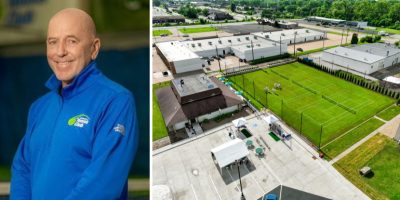
 Ernie Katko is the director of the high-performance program at Quad City Tennis Club in Moline, Ill.
“Each kid has different qualities,” Katko said. “Some kids will be good in certain areas; others will be good emotionally or technically. I don’t think it’s just one issue. When you look at players even at the US Open, everybody has a different quality. That’s the way I look at it with juniors.”
One could argue that athleticism is the most important aspect of the game. No matter how technical some players are, they may not compete at the highest levels because of a lack of athleticism. But Katko believes that being sound technically is as important as anything.
“It’s very important to get that started early,” he said. “Whether it’s groundstrokes, the serve or something else, if they’re technically sound the tactics come easier.
“If a player is not developed technically, it makes it much more difficult tactically. I think I’ve always been focused on the technical aspects of tennis.”
He just does it at a slower pace in LeClaire, Iowa, than he did in New York and Chicago.
Learn more about USTA Coaching here. Check out additional Coach Appreciation Month stories from across USTA Missouri Valley here.
Related Articles
-
 Technically SpeakingOctober 09, 2026Ernie Katko has spent decades developing tennis players, and his technical approach continues to help juniors at Quad City Tennis Club build their games. Read More
 -
 College Facility UpgradesSeptember 25, 2026Five Iowa colleges are investing more than $450,000 in tennis facility upgrades, using USTA Tennis Venue Services grants to resurface courts and strengthen their programs. Read More
 -
 Panthers' Fresh StartSeptember 03, 2026United Township tennis in East Moline is ready to bounce back. After years of worn surfaces, all nine courts have been resurfaced with support from USTA grants. Read More
Sign up for our Newsletter
Download the USTA App

