50 years of wheelchair tennis: Dan James, Jon Rydberg and Jason Harnett, the architects
Wheelchair tennis originated with Brad Parks in 1976, and its growth over the past 50 years has blossomed through the work of wheelchair tennis advocates, who have dedicated their lives to showing the world that tennis welcomes everyone. The story of wheelchair tennis would be incomplete without recognizing Dan James, Jon Rydberg and Jason Harnett—three tennis players, turned wheelchair tennis coaches, whose stories weave together to create the essential structure that helped the sport to grow—and continue to help it thrive.
James’ introduction to wheelchair tennis was a surprise. An able-bodied teaching pro at his local Minnesota tennis club in 1992, he was teaching any drill or lesson he could. One day, he was assigned to a court with 10 wheelchair tennis players. Learning and teaching on the fly, James unlocked a passion he never realized was there.
“They all smiled at me and they made me play [in a chair] the last half hour,” James recalled. “I fell out three times, and I fell in love immediately.”
James volunteered as a wheelchair tennis coach for eight years. In 2003, he became the USTA’s first-ever National Manager and Head Coach of wheelchair tennis. He then became Tournament Director for the US Open Wheelchair Competition, which started in 2005. He went on to serve as Head Coach for the U.S. Paralympic Tennis Team, World Team Cup, U.S. Paralympic Teams and Parapan American Teams.
Equally as impressive as his resume is James’ attitude. His humanity drives his sense of purpose, says Harnett, the man who succeeded James as the USTA wheelchair tennis National Manager in 2016.
“He loves the players. He did great work in spreading the word and the message of what tennis does for anybody, especially for people with disabilities who are looking for a focus,” Harnett said.
“I think he loved the challenge; he loved trying to bring wheelchair tennis to the forefront. He’ll be remembered as someone who drew people to the sport.”
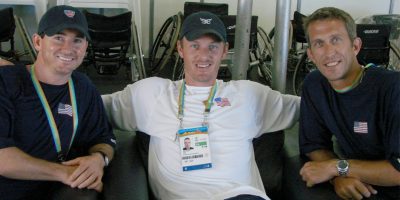
 Jason Harnett, Jon Rydberg and Dan James together at a tournament. Photo courtesy of Jon Rydberg.
James’ influence through the 2000s and 2010s is prolific. He created a camp structure for wheelchair tennis players and helped formalize game play rules. He helped support the Silver Fund, a World Tennis program that brought wheelchair tennis to developing nations.
“I realized that for all of us, tennis is a vehicle to us finding our best selves,” James said. “My best coaching moments were the moments I wasn't a part of—when I got to see what wheelchair tennis does for the development of human beings.”
One of those key human beings was Rydberg, who was on those courts the day James first coached wheelchair tennis in 1992.
Rydberg’s tennis career began on crutches. Growing up in a small town in Minnesota, Rydberg didn’t learn about wheelchair tennis until he attended a disabled sports camp. Born into a family of tennis enthusiasts, they always encouraged him to participate in any sport he wanted.
He pursued the sport after attending an event with wheelchair tennis icon and International Tennis Hall of Famer Randy Snow, and traveled around the Twin Cities to hit with other wheelchair players. James started coaching him, accompanying him on most of those hitting sessions, up until Rydberg left to play wheelchair basketball on scholarship at the University of Texas-Arlington.
“We were kind of attached at the hip for many years, living in the same state and being involved in the same sport as coach and player, and obviously friends as well, since the beginning,” Rydberg said. “It’s not every day that you get an able-bodied player and coach that wants to be invested in our space.”
 Jon Rydberg and Dan James celebrating a wheelchair tennis victory. Photo courtesy of Jon Rydberg.
Their coaching relationship continued after Rydberg’s college basketball career, when he returned to tennis and developed an exceptional, three-decade professional wheelchair tennis career. Rydberg went on to hit a career-high ranking of No. 11 in singles and No. 13 in doubles and become a US Open wheelchair singles semifinalist. He accumulated accolades across the globe, including multiple gold and silver medals at the Parapan American Games, and competed in four Paralympic Games and 14 World Team Cups.
“It was his dogged determination to find a way to win, to find a way to succeed. This is a guy who played high school tennis on his crutches,” James said. “His ability to find a way to win was only matched by his athletic ability.”
Rydberg’s impact on the game continues, in part by an invitation from Harnett. The same year that Harnett succeeded James as the USTA wheelchair tennis National Manager, Rydberg retired from professional wheelchair tennis. Harnett felt it was only natural for Rydberg to join the USTA as a High Performance National Coach, and the U.S. men’s captain for World Team Cup.
“As one of the greatest men's players we've ever had, it made sense for him to take on our new, younger players, because they all looked up to him,” Harnett said.
This new chapter led to other leadership roles for Rydberg, including multiple committee appointments, and currently, on the USTA Board of Directors.
“I wanted to have a little bit more of a voice for tennis overall, but especially [for] wheelchair. I felt maybe I could lend my experience from over the decades [to formulate a plan] of where we should go, how we should do it, and fill some voids where we need them filled,” Rydberg said.
The journey from player, to coach, to board member isn’t very common, and the significance of that unique journey isn’t lost on either Harnett or James.
“He's one of those absolute key ingredients. Like when you make your favorite dish, and it doesn’t work without that one ingredient. That’s Jon,” Harnett said. “Again, he is a great player, now he's a World Team Cup captain, a Paralympic coach, a Parapan American coach. He's got all that playing side [and] coaching side credibility. And now he's a [USTA] board member. That's never happened in history, ever.”
Harnett played a significant role in bringing Rydberg into the coaching fold, but that only scratches the surface of Harnett’s own impact on the sport. An integral member of the USTA’s high performance wheelchair tennis structure since 1998, Harnett has built an esteemed reputation for championing the sport and its athletes. He’s coached the country’s top wheelchair tennis players, captained many World Team Cup teams to medal finishes and represented the USA as head coach in multiple Paralympic Games.
“When you do something for a long time and it’s been your life passion, when you leave it you hope someone has the ability to make it better, to do more than you were capable of doing—and that's what Jason has done,” James said. “We grew up together in the sport. We were peers, we were partners, and so I feel like Jason was more than ready to take the reins.
“He has taken this vision we've had since 1998 and brought it to fruition. And to be able to watch from the outside now is so incredible.”
 Jason Harnett, USTA Director and National Head Coach of wheelchair tennis, at a team wheelchair tennis event. Photo courtesy of Jason Harnett.
In his 10 years as the USTA Director and National Head Coach of wheelchair tennis, Harnett has worked tirelessly to better integrate wheelchair tennis into both the USTA and international landscape. He helped grow the National Collegiate Wheelchair Championships when it was held at the USTA National Campus. He’s pushed for more representation for wheelchair athletes at the US Open, helping expand draw sizes and increase prize money. He played a large role in the addition of juniors to the US Open in 2022—marking the first Grand Slam to include a junior wheelchair tennis competition.
“It's my turn right now, but someday it will be someone else,” Harnett said. That seems to be the ethos for Harnett, Rydberg and James. Wheelchair tennis’ story began with people who willed the sport into existence, and the chapters continue as more people believe in its mission.
“Our journeys have been so intertwined: Jon [Rydberg] and I from the very beginning in 1992, Jason [Harnett] and I had our first World Team Cup together in 1998,” James said. “I don't think my story can be told without those two men, and I don't think their stories can be told without each other. We're linked in a way that makes any level of impact shared, no matter who gets the credit.
“We just continue being advocates of the opportunities that wheelchair tennis creates, and I will do that for the rest of my life.”
Related Articles
-
 Wheelchair 50: architectsNovember 11, 2026Dan James, Jon Rydberg and Jason Harnett knew growing wheelchair tennis would be challenging, but their love for the sport and its athletes fueled their drive. Read More
-
 Wheelchair 50: MoniqueAugust 23, 2026In celebration of 50 years of wheelchair tennis, the USTA honors the incredible career of wheelchair tennis star Monique Kalkman-van den Bosch. Read More
-
 Wheelchair 50: ChantalAugust 21, 2026In celebration of 50 years of wheelchair tennis, the USTA reflects on the legacy of Chantal Vandierendonck, the first women's star in the sport and a catalyst for the growth of the game in the Netherlands and around the world. Read More


Sign up for our Newsletter
Download the USTA App

