How a crisis management professional became a tennis official: ‘It’s just one more mini-crisis to manage’
In St. Louis and around the United States, few people embody tennis’ many dimensions quite like Liz Lahm. A former Division I player at Saint Louis University, she now gives back to the game as a high school coach and USTA official, alongside her work as a USTA League coordinator for USTA St. Louis in Missouri Valley.
Lahm has spent her career learning to see the sport from every angle—and to keep calm under pressure, no matter which role she’s in.
That composure didn’t come from tennis alone. Before joining the officiating ranks, Lahm spent 25 years working in crisis management and emergency response for a local utility company.
“To me, officiating and getting into being on the courts was just one more mini-crisis that I could manage,” said Lahm, who is now in her third year as an official and her seventh season coaching the girls’ team at Notre Dame High School. She also continues to compete in USTA League tennis.
Read on for a Q&A about Liz’s officiating journey and how it complements her work as a coach.
Q: How did you first get into officiating?
Liz Lahm: In one of our monthly meetings at USTA St. Louis, we were really focused on the fact that there was such a shortage of officials. At that time, in March of 2023, we were getting into the end of the season for adult leagues and starting up summer leagues, and then St. Louis hosts a lot of district tournaments and junior events.
 Liz Lahm has been a USTA official for three years and a high school tennis coach for seven seasons. Photos courtesy of Liz Lahm.
They were having a hard time locking in L5 events or higher because you are required to have an official for those. It piqued my interest and so I started taking classes to become certified.
For me, it was like a turning point and a great way to use my experience working in crisis management. And so I went through and I took all the training, and I've been working a ton since. There were eight officials when I started in St. Louis, and we are up to 16 right now.
I feel like coaching, being a player and being an official is all continuing to pay it forward in the tennis community.
 Coach Lahm (center) with her Notre Dame High School girls' tennis team.
Q: How much do you feel your coaching background helped you as an official, or vice versa?
Liz Lahm: I think they're very complementary roles. The officiating experience helps me to instill fair play in my high school tennis team. If you call the ball in when you're questioning it, that's exactly right. You call it out only when you see it clearly, and if somebody's going to question you on it, you stand behind your call. You see it like you play it.
Vice versa, as an official I will say to the players: “This is your warning. I want you to make fair calls and be a good sport at all times.”
And then as an official, you have to overrule. In high school, if I see a bad call by one of my players and I'm standing at the court, I will overrule them because I think that's the right way to instill proper play. They're very complementary roles. You just have to know which hat you're wearing at what time.
I've also been encouraging the high school players to explore becoming officials, because if they are already players, then they're 90% of the way through. They may not know all the rules, because the rule book is a little thick and high school doesn't cover them all. But we've been working on how we could get more high school kids to become officials because it's conducive to their schedules. Most of the events are on the weekends.
I give brochures out every year to the students who come through the program and tell them about it. And we are working on a one-day learning program to streamline the process of becoming an official.
Q: When you started your officiating career three years ago, did anything surprise you?
Liz Lahm: My very first solo officiating assignment was an adult sectionals, and within the first hour, I overruled a gentleman’s call. He threw his racquet and launched a ball out of the court, so I gave him a point penalty.
I'm a petite girl and he was probably 6-4. He came storming up to me and accused me of favoring the St. Louis players, and I said, “Well to be honest with you, I don't know who's from St. Louis. I'm just calling the rules as they are, which is my job on the court.”
I was very taken back by how he reacted, but since then I come at it a different way. I know they're going to be very emphatic on their calls or how they're playing, and how it shouldn't be a penalty or whatever. I just have to put a little empathy on it.
Like, “Hey, I understand your position, I also play. But here's what happened.”
I just have to explain myself, and certainly not to back down—because if you hesitate just for a brief moment, they're going to take that opening. You certainly don't want to recant what you did, but on the flip side, if you really made an erroneous call or you didn't make the call when you should have, then you have to own up to it.
So those are a couple of things that I was surprised by. I should have expected it, but I didn't think it would be hour one, day one.
Q: What are your future plans or goals in officiating?
Liz Lahm: I will continue officiating because I still find it enjoyable and I think there's a need for it. I’m also a collegiate official, so I work for the ITA as well. I find the USTA matches much more a learning moment, a teaching moment, a give-back moment—as opposed to when you get into the collegiate level, it's very intense.
I like to be able to interact with the players while I’m officiating. If I work the L7 tournaments with beginners, I'm often helping them understand the rules. Some of them don't know when they're supposed to switch sides or when a water break is appropriate and all that kind of stuff.
But I enjoy all levels of it, all the way up to the highest-level USTA tournament I've worked, an L3, and then regional college tournaments, where I’ve sat in a chair.
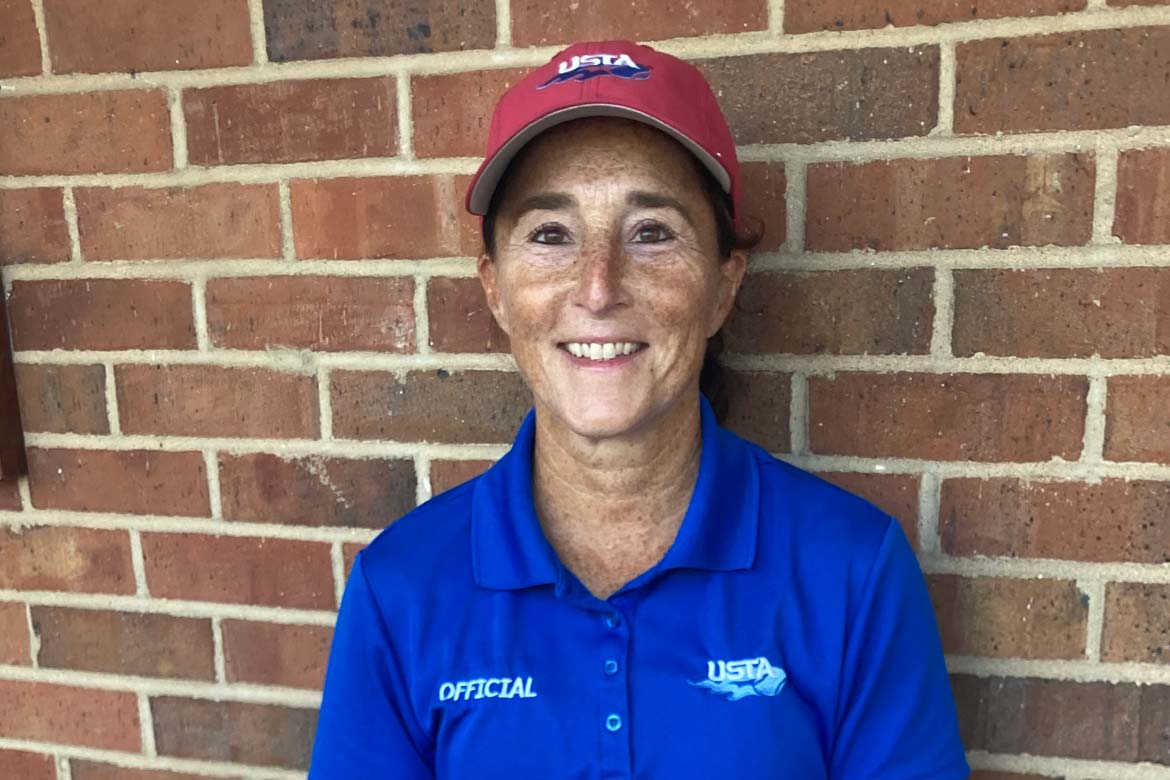 Lahm in her USTA officiating uniform.
I find it all very rewarding and a positive way to stay involved in tennis, so I have no intention of backing out at any time soon. I've only been doing it for a couple years and I know there's people out there who've been doing this for 30.
There are so many tournaments locally that I could work every weekend for six or seven straight months and won't ever have to travel. I know there's several of my official peers who travel and do all sorts of stuff like that, but I feel it's important to stay local and give back here, where my roots are.
Learn more about USTA Officiating and USTA Coaching.
Related Articles
-
 2026 Champs of EqualityOctober 20, 2026Kaitlin Roselius, Marcy Hirshberg and Kathy Connelly were recognized at the 2026 US Open during the fourth annual Champions of Equality event. Read More
 -
 USTA and Special OlympicsOctober 19, 2026This new collaboration will officially launch at the 2026 USTA National IDD Championships, taking place October 22-25 at the USTA National Campus in Orlando, Fla. Read More
 -
 FSNM Gala nets $1.5mOctober 19, 2026Andre Agassi, Steffi Graf, Martina Navratilova and other tennis legends helped raise $1.5 million for the First Serve New Mexico Foundation, a USTA NJTL chapter. Read More


Sign up for our Newsletter
Download the USTA App

