In their own words: Beth Hopkins on representation and recognition
As we celebrate Black History Month throughout February, we look toward leaders in tennis who are working to spread this sport far and wide, reaching deep into communities to impact youth on many levels. This month, you'll meet volunteer leaders who are telling their first-person stories and who recognize the influences family, friends, teachers and coaches have had on the direction their lives and careers have taken—and how that direction is positively impacting the newest generations. Today, meet Beth Hopkins.
When I was growing up in Petersburg, Va., we all were aware of Arthur Ashe and Althea Gibson and the roles they played in getting Black people interested in tennis. But I grew up in a town that did not have public courts for people of color.
At Wake Forest, I was one of only two African American women living on campus. I graduated with honors in 1973; however, I was denied admission to Wake Forest’s Law School because it had filled its quota of Black students, which was two. So I received my law degree from the Marshall-Wythe School of Law, College of William and Mary in 1978. My legal career includes working as a civil rights attorney and then as a Virginia assistant Attorney General and an assistant U.S. Attorney.
I started volunteering in tennis more than 20 years ago. Currently, I serve on the USTA National Diversity, Equity and Inclusion Committee, and one of my projects, working with the visionary Pete Peterson, is to run a Tennis Play Day for children of the Native American Lumbee Tribe in North Carolina, which is planned for March.
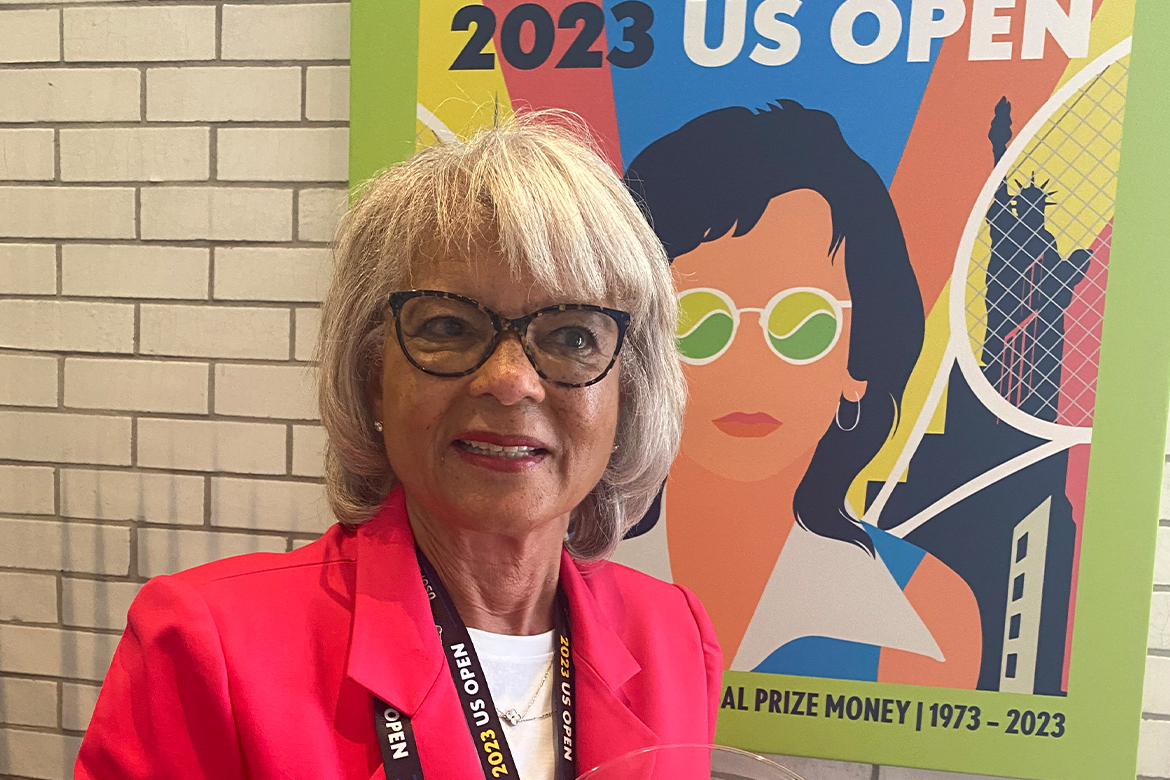 Beth Hopkins at the 2023 US Open. Photo courtesy of Beth Hopkins.
Also, I am a member of the USTA Southern Section Board of Directors, and liaison with both the Awards and DEI committees. (As a result of my interest in tennis, I am pleased that my son, David Hopkins, played No. 1 at Wake Forest, and is a volunteer on a USTA Northern California committee.) Previously, I was the chair of the USTA National Constitution and Rules Committee.
I am extremely proud of how the USTA has chronicled the contribution of African American players and coaches, and their historic achievements. It is so important that we continue to honor those who have come before us and laid the foundation for my generation and generations to follow. But recognition of Black history achievers should run throughout the year, not just for the month of February. It is truly unfortunate that some states have decided to eliminate this recognition and the importance it brings to recognizing our history and growth—not just for African Americans, but for this nation overall.
Within the USTA, we have taken historic leaps together. We make it clear we are an inclusive organization which addresses diversity in thought and deed. For me, the USTA is a magical organization.
[Editor’s note: At the 2023 US Open, Beth Hopkins was honored as one of the USTA’s Champions of Equality. She previously was honored with the Southern Tennis Association Volunteer of the Year Award in 2012, and received the Martin Luther King Dare to Make a Difference Award in Winston-Salem. Her most recent honors include the ACC Unity Award, and being named Wake Forest Distinguished Alumnus of the Year for 2023.]
Related Articles
-
 Ahsha Rolle: BHMFebruary 27, 2026Ahsha Rolle, former professional tennis player and current executive director of tennis at New York Junior Tennis & Learning (NYJTL) and the Cary Leeds Center for Tennis & Learning, pens an essay on the importance of being a role model and giving back so the next generation can thrive. Read More
 -
 Damita Curry: BHMFebruary 25, 2026Damita Curry, the executive director of the Southwest Tennis Foundation (SWTF) and a member of the USTA National Advocacy Committee, writes a first-person essay on what tennis means to her, especially during Black History Month. Read More
 -
 Traci Green: BHMFebruary 20, 2026Traci Green, a USTA Board Presidential appointee, volunteer on the USTA Collegiate Pathway Committee and head coach of the Harvard women's tennis team writes a first-person essay on what the sport means to her. Read More


Sign up for our Newsletter
Download the USTA App

