In their own words: Kim Coston on the joys of tennis and giving back
As we celebrate Black History Month throughout February, we look toward leaders in tennis who are working to spread this sport far and wide, reaching deep into communities to impact youth and adults on many levels. This month, you'll meet USTA national volunteer leaders who are telling their first-person stories and who recognize the influences family, friends, teachers and coaches have had on the direction their lives and careers have taken—and how that direction is positively impacting the newest generations. Today, meet Kim McMillon Coston.
I started playing tennis as an adult in 1991, captaining what I believe was the first NTRP 2.5 women’s “public parks” team in Charlotte, N.C. We were a group of ladies of all ages and backgrounds who had just picked up the game and thought we were better than we actually were! What is most important today, is still important… we were having fun, created new friendships, and involved in organized play.
We played two teams from local clubs, home and away. We had an 0-4 record, losing every match—but we just had the BEST time. We stayed together as a team, secured our own coach, Calvin Davis, Jr., of the Tennis Advancement Program. Eventually, we reached our goal of winning the local league as 3.0 players, which was played at Pinehurst Resort in North Carolina, going all the way to the USTA Nationals for 3.0 in Palm Desert, Calif. We lost in the finals, but it was an incredible experience. I continue to play USTA League tennis, interclub, and the occasional tournament for fun.
I’m so thankful to be able to give back to this sport that has given so much to me. I just completed a two-year term as president of USTA North Carolina—the first person of color to serve in this capacity. I’m also completing my second year of the 2025-2026 term as co-chair of the USTA Southern’s Schools Committee and the USTA National Volunteer Engagement Committee, where I chair the mentoring sub-committee.
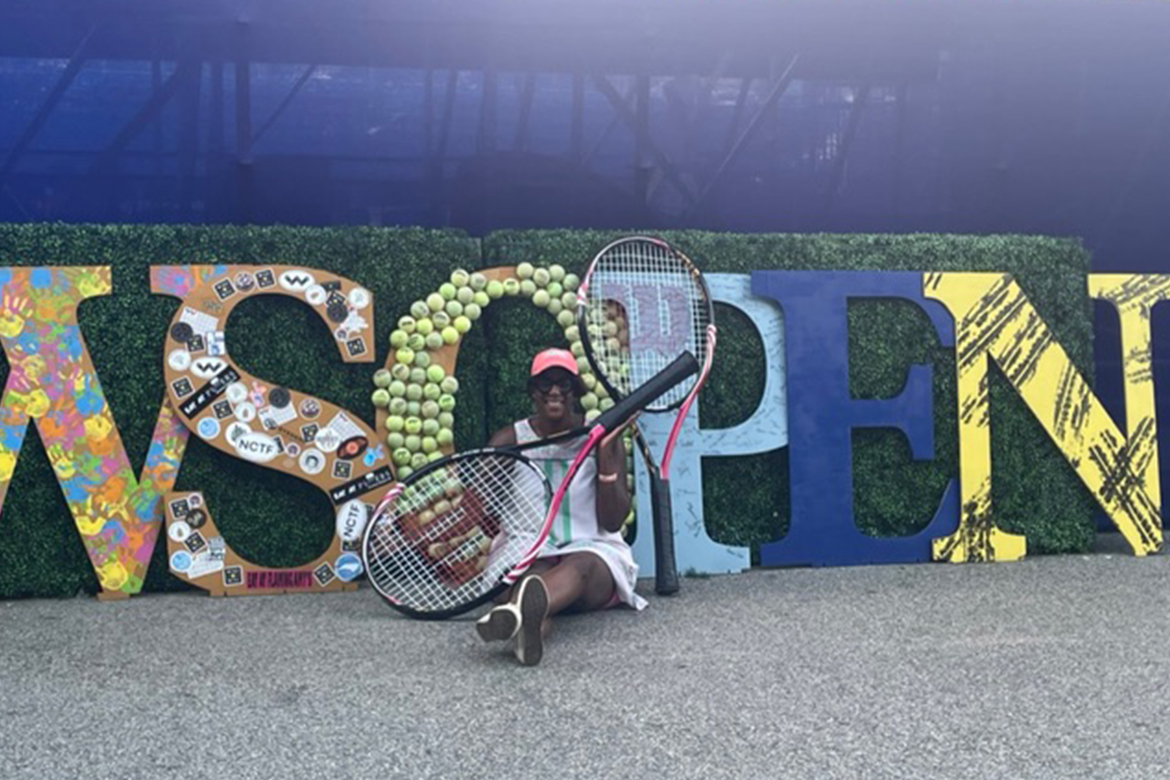 Kim Coston poses with giant tennis racquets at the Winston-Salem Open. Photo courtesy of Kim Coston.
This ties in nicely with my professional career. I’ve been a leader at Bank of America for 17 years, most recently seven years in Global Opportunity and Inclusion. In 2014, I co-created a leadership development program, Professional Development Experience, for one of our organizations which earned me a 2015 Global Opportunity and Inclusion Award from Bank of America. In 2026, I transitioned into a wonderful new role within the bank’s academy supporting global inclusion learning.
I’ve had many mentors professionally, most are other African-American women who have helped me navigate leading—in non-traditional industries—for black females (e.g. advertising, marketing, paper industry, defense, space systems, etc.). In the USTA, many people of all genders, races, and ethnicities within USTA North Carolina and the Southern section have and continue to guide and mentor me.
 Kim Coston poses for a photo at the US Open. Photo courtesy of Kim Coston.
I’m honored to be part of the USTA, which is committed to diversity, inclusion and expanding access to opportunity. In today’s social and political climate, we are, sadly, seeing more barriers being erected for historically underserved communities—some barriers that took generations to dismantle.
Black History Month provides an important opportunity to reflect on the full history of America—including painful and uncomfortable truths—from slavery and segregation, to the progress of desegregation and expanded access, to powerful evidence of progress such as the election of the first Black president of the United States.
February is a time to honor the resilience, sacrifices, contributions and leadership of Black Americans who helped shape this country.
As a nation, it is critical that we do not lose sight of our past or the lessons it offers. Opportunity and inclusion are foundational to what America stands for as a land of possibility and what distinguishes us as a nation. Within tennis, we celebrate trailblazers like Althea Gibson and Arthur Ashe, who paved the way not only for future generations on the court, but for progress in society as a whole. We must all remember, irrespective of your background, that we share a responsibility to protect and advance opportunity and inclusion for all.
Related Articles
-
 Ahsha Rolle: BHMFebruary 27, 2026Ahsha Rolle, former professional tennis player and current executive director of tennis at New York Junior Tennis & Learning (NYJTL) and the Cary Leeds Center for Tennis & Learning, pens an essay on the importance of being a role model and giving back so the next generation can thrive. Read More
 -
 Damita Curry: BHMFebruary 25, 2026Damita Curry, the executive director of the Southwest Tennis Foundation (SWTF) and a member of the USTA National Advocacy Committee, writes a first-person essay on what tennis means to her, especially during Black History Month. Read More
 -
 Traci Green: BHMFebruary 20, 2026Traci Green, a USTA Board Presidential appointee, volunteer on the USTA Collegiate Pathway Committee and head coach of the Harvard women's tennis team writes a first-person essay on what the sport means to her. Read More
Sign up for our Newsletter
Download the USTA App

