In their own words: Sara Hong shares her desire to give back to the tennis community
As we celebrate Asian American and Pacific Islander Heritage Month throughout May, we look to amplify the voices of AAPI leaders in tennis who are working to spread this sport far and wide. This month, you'll meet leaders who are telling their first-person stories and who recognize the influences family, friends, players, teachers and coaches have had on the direction their lives and careers have taken—and how that direction is positively impacting the newest generations. Today, meet Sara Hong.
I picked up a racquet about 15 years ago when my son was first learning tennis, and what started as a casual way to stay active through adult leagues turned into something I couldn't imagine my life without.
I'm not a former college player or a lifelong competitor. I came to this sport as a regular adult who fell in love with it, and that has shaped everything about how I think about growing the game. Living in Minneapolis means navigating a short outdoor season and long winters, which makes the tennis community here feel especially tight-knit. Much like Minnesotans in general, the USTA Northern Section tennis community has a particular strength in showing up for each other, and in 2017 I wanted to be one of them, so I joined the Serving Up Love committee as a volunteer.
The reason was simple: Tennis had become such a meaningful part of our family's life and I wanted to give something back. Serving Up Love worked to make the sport more reachable for those who might not otherwise have access, through financial assistance for juniors and by collecting and distributing donated equipment to under-resourced tennis programs and individuals.
 Sara Hong posing with a tennis trophy. Photo courtesy of Sara Hong.
What I didn't anticipate was how much that work would open my eyes to how many people don't see themselves reflected in this sport, whether because of background, experience level, or just not knowing where to start. Making tennis more accessible for players of all backgrounds and experiences became my focus—and it has stayed there ever since.
That volunteer work led to other committee roles at USTA Northern, a seat on the Section Board of Directors, and now the role of incoming USTA Northern President. I currently serve as VP on the Executive Committee and am part of the national USTA Emerging Leaders Committee. It wasn't a straight path, but it all started from the same motivation.
In my professional life, I've spent my career in innovation and new product development, and I love bringing that mindset to my work with USTA. Asking, "What if we tried it differently?" feels just as natural in a committee meeting as it does in my day job.
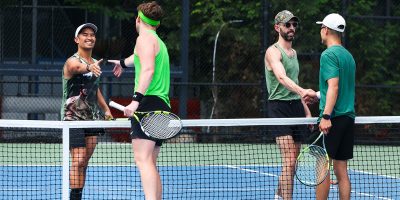
 Sara Hong poses with a tennis partner after a match. Photo courtesy of Sara Hong.
As a Korean-American, May holds a particular meaning for me. AAPI Heritage Month is a chance to reflect on what it means to be part of communities that have often been overlooked, not just on the court, but in the rooms where decisions get made. Here in Minneapolis, we have a vibrant and growing AAPI community and yet when I look at tennis participation and leadership, that richness isn't always reflected back. That gap matters, because the sport is so much better when it mirrors the full diversity of the communities it serves.
Growing up, I didn't see many people who looked like me in leadership and I still don't see enough. Within the USTA and tennis more broadly, representation isn't just about optics. AAPI professionals are often well represented in technical and individual contributor roles, but leadership positions, whether in corporate boardrooms or in the governance of large organizations, tell a different story.
Breaking into those spaces requires not just capability but also someone willing to open the door and hold it. That is something I think about constantly in both my professional life and my work with USTA. It matters deeply to me, because representation shapes who feels welcome, who feels like they belong, and who believes a leadership role is even within reach for them.
When people from AAPI backgrounds see someone who looks like them chairing a meeting, setting a strategic direction, or holding a title like president, something shifts. That possibility becomes real in a way it wasn't before, and that ripple effect is powerful. My hope is that by being visible in this role, I can make it a little easier for the next Korean-American woman, or any AAPI person, who walks onto a court or into a boardroom wondering if there's a place for them. There is. The door is open and being held. We need their voices, their energy and their perspective to make tennis stronger for everyone.
Related Articles
-
 USTA and Special OlympicsOctober 19, 2026This new collaboration will officially launch at the 2026 USTA National IDD Championships, taking place October 22-25 at the USTA National Campus in Orlando, Fla. Read More
 -
 Profile: Dimas MendezOctober 15, 2026Coach Dimas Mendez of Puerto Rico used a career in stringing as a gateway into professional tennis as he chased his ultimate goal of coaching. Read More
 -
 Liberty Open 2026July 23, 2026Hosted at the USTA Billie Jean King National Tennis Center, the Liberty Open drew more than 150 participants to celebrate the power of tennis for all. Read More


Sign up for our Newsletter
Download the USTA App

