Coach Larry Campton spreads love for tennis through inventive teaching methods
Do you like tennis? Then Larry Campton may not be the coach for you.
"The first thing I tell my players is that I love tennis," Campton explained. "So when I meet new students, I say, 'Do you like tennis?' And if they say yes, I say, 'I'm not teaching you! If you don't love it, I'm not teaching you," he joked.
"My players love tennis. And I love teaching tennis," said the Rockton, Illinois, resident, who lives on the Wisconsin border.
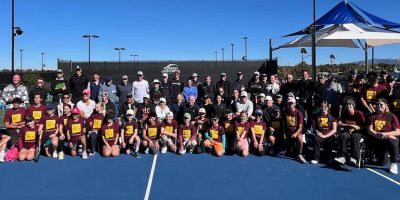
For 40 years, Campton has been giving free tennis lessons to anyone willing to learn, from toddlers as young as 2 to retirees as old as 94. Over 500 students have come under his guidance, many from disadvantaged backgrounds.
"A lot of people I work with are broken-home kids that don't have money. I come from a broken-up home," Campton shared in a recent interview with USTA.com. "My parents didn't have money. My first racquet was $1.99, a wooden racquet from a drugstore." He fondly remembers his first "nice" racquet—a $20 Wilson Mustang—gifted to him by his mother in junior high school.
Now the President of the Beloit Tennis Association in Wisconsin, Campton previously coached both boys' and girls' teams at Beloit College and a local high school. He has shared his passion with students from all walks of life, including players who have physical and mental disabilities, helping them find joy and confidence on the court.
As a player, Campton boasts an impressive collection of more than 250 trophies, winning USTA state titles seven times at the 4.5 level in Wisconsin. Like his tennis idol, Jimmy Connors, he also learned the game in public parks.
 Photo courtesy of Larry Campton.
 Photo courtesy of Larry Campton.
 Photo courtesy of Larry Campton.
 Photo courtesy of Larry Campton.
- Larry Campton
- Larry Campton
- Larry Campton
- Larry Campton
Read more: 'Public park kid' Jimmy Connors reflects on how public courts shaped him and his tennis
"Me and my brother used to walk into the park and play tennis," said Campton, whose brother passed away nine years ago. "I never took a tennis lesson in my life. I just got better by reading books, watching tennis on TV, and going to the park, hitting against the backboard."
Campton’s inventive coaching setup is a hallmark of his unconventional approach. Using a net he acquired from Beloit College—originally used for shot put and discus—he transformed his 24' by 28' garage into a practice area.
"I put the net up, and then I put a blanket behind it," he explained. "My students hit the ball as hard as they can into the blanket, and I've got three or four 30-gallon drums sitting there to catch the balls."
His drills are equally unique, no matter the setting. One favorite sees him hitting a forehand, a between-the-legs shot and a behind-the-back shot against a wall, over and over, in that order. For his students, he might have them practice their aim by hitting through a gate or over a fence—always toward a target.
"Tennis to me is all rhythm," Campton said of his philosophy. 'The more rhythm you get, the better you're going to be. I tell all the people I've taught that tennis is all between the ears. 'I can,' not 'I can't.'" That can-do mentality extends to his coaching, typified by his ability to teach the game just as well inside or outside the lines of a regulation tennis court.
A lifelong fan of the sport, Campton visited New York to attend the 1996 US Open, his only time on an airplane. He watched three of that year's champions play: Pete Sampras, Steffi Graf and the Bryan brothers, who won the junior doubles title. Memories of his trip to America's Grand Slam continue to inspire him as he teaches future generations to love of tennis.
Related Articles
-
 2026 Champs of EqualityOctober 20, 2026Kaitlin Roselius, Marcy Hirshberg and Kathy Connelly were recognized at the 2026 US Open during the fourth annual Champions of Equality event. Read More
 -
 USTA and Special OlympicsOctober 19, 2026This new collaboration will officially launch at the 2026 USTA National IDD Championships, taking place October 22-25 at the USTA National Campus in Orlando, Fla. Read More
 -
 FSNM Gala nets $1.5mOctober 19, 2026Andre Agassi, Steffi Graf, Martina Navratilova and other tennis legends helped raise $1.5 million for the First Serve New Mexico Foundation, a USTA NJTL chapter. Read More


Sign up for our Newsletter
Download the USTA App

