Q&A: Kentucky teacher Jackie Branham on tennis in physical education classes
Jackie Branham teaches physical education to kindergarteners through fifth graders at The Promise Academy at William Wells Brown Elementary and Rise STEM Academy for Girls in Lexington, Ky. She has taught in this district since 1999, and teaches between three and nine classes a day between the two schools.
Branham started incorporating tennis into her curriculum at The Promise Academy a couple of years ago, and has since requested a free Net Generation equipment kit from the USTA for Rise STEM Academy for Girls. In a short period of time, she has piqued the interest of her students across grade levels and exposed them to a sport they can play for the rest of their lives.
As this school year wraps up, USTA.com sat down with Branham to learn more about her experience with the Tennis in Schools program and what she thinks other physical education teachers should know.
This conversation has been edited and condensed for length and clarity.
USTA.com: How did you get involved in tennis and start teaching it in your classes?
Jackie Branham: I had to take it in college, and I worked at a tennis camp at the University of Kentucky for one summer. That's the closest I have ever been to tennis in my life. In college, I was like, “I've never had tennis, let's try it and see what happens,” and I had a blast.
Then I went to Kentucky SHAPE (a physical education conference) right before COVID-19, and was like, “Oh, this is free, and if I liked it when I had a chance to do it, I think my students need to be exposed to it.”
USTA.com: How do you teach tennis, and how do you change the curriculum for the different ages or skill levels in your classes?
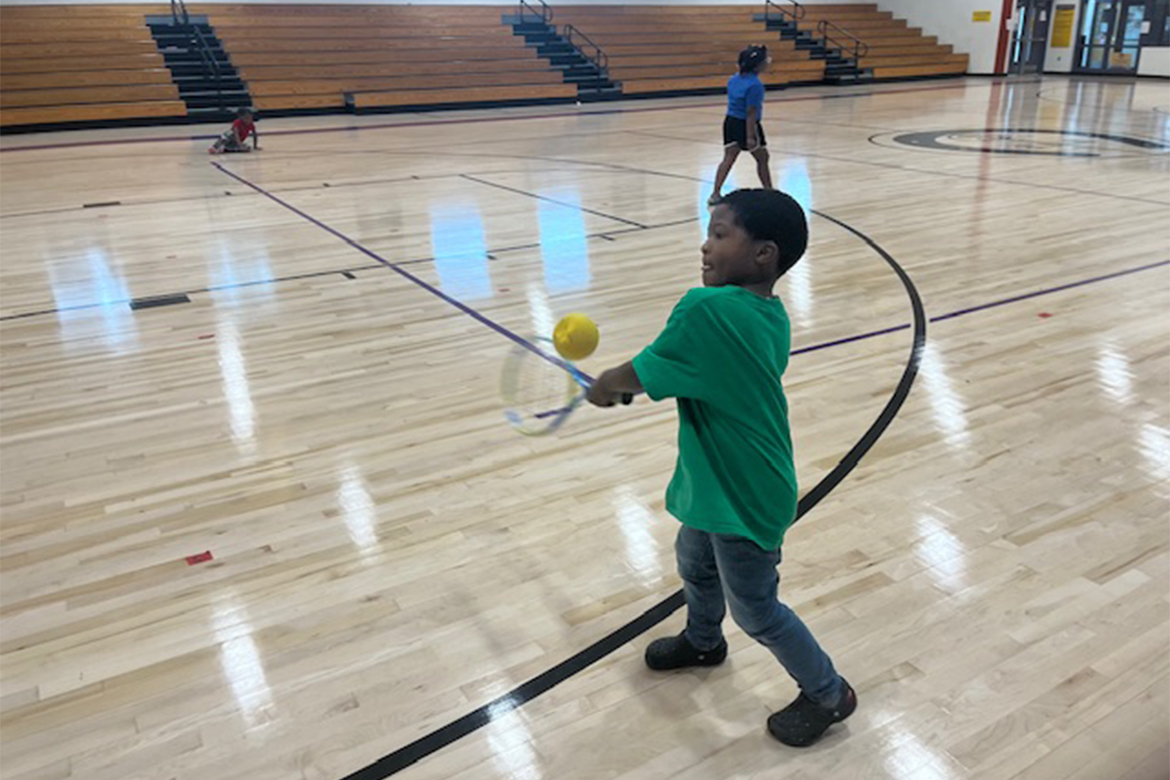 Photo courtesy of Jackie Branham.
Jackie Branham: With kindergarten, we start out with just racquet skills, this is the ball that you have, this is the racquet. I don't really get into specifics with kindergarten and first grade because it's hard for them to hold the racquet because it's new to them, and then I use more of the [provided] lessons with the third, fourth and fifth [grade]. And they want to jump straight into play. And I'm like, we got to learn how to hold the racquet, learn how to serve and how to play a game. We start from scratch every single year with the primary [students] and then add on in the third, fourth and fifth [grades] because they've already done it the previous year.
I use a big ball for primary [classes] and then I use the red and yellow ones, which are a little harder, for the intermediate ones, mainly the fifth [grade], because sometimes third grade doesn't have that skill just yet, so we're still working on that eye-hand coordination just like the primary [students].
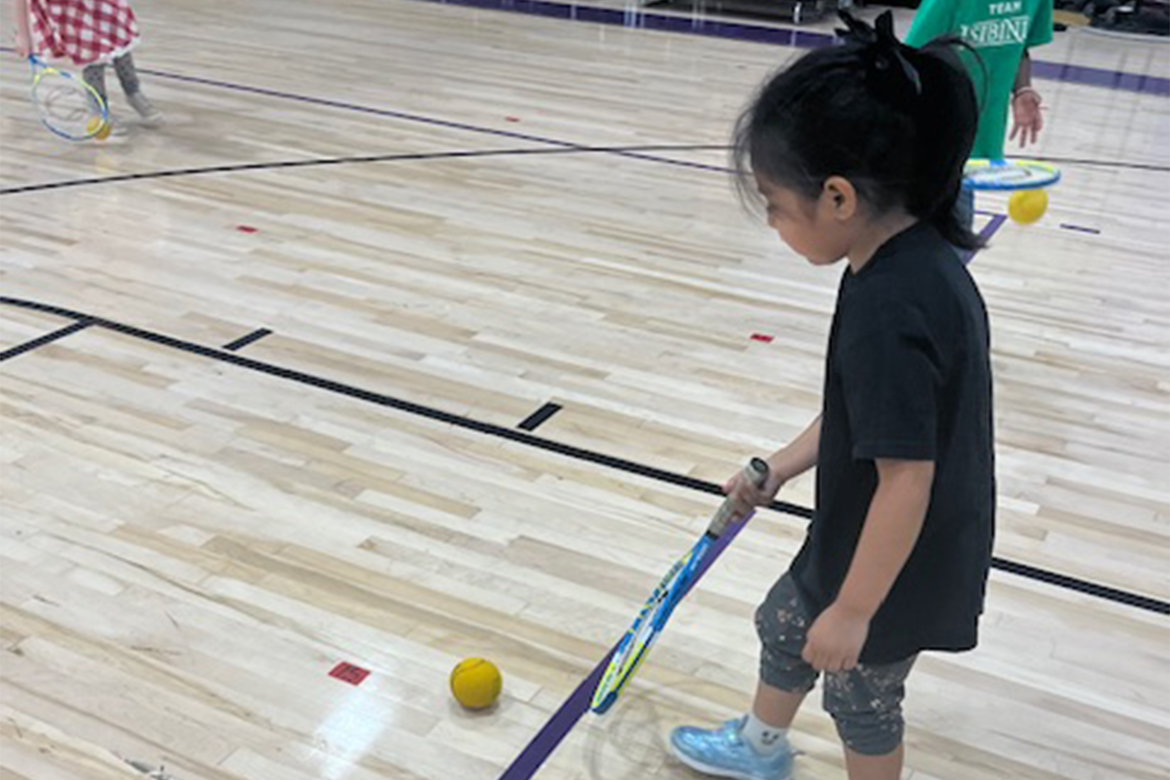 Photo courtesy of Jackie Branham.
USTA.com: What are some of the activities and exercises you do?
Jackie Branham: Bouncing the ball, carrying the ball on the racquet, holding the racquet so they can get used to the weight of the racquet, trying to control it without bouncing the ball. I tell them this is like you have an egg in a skillet and you're just trying to hold it on there without it dropping off. And then after we've done that for a while, we'll do it as a warm up each time. Now we're flipping pancakes, so you can bounce the ball up. I gave them a small dot, something flat, so they can flip it like they're flipping pancakes. We do more skill stuff when I have the [kindergartners, first graders and second graders], then the games, and we'll play games like “walk the dog” and do stuff like that.
[We see if] they can hit it up in the air four or five times in a row. And if you can do five, can you make it to seven? Can you make it to ten?
USTA.com: Then when they get older is it more match play or rallying?
Jackie Branham: Yes, we do that. We practice without the net—we practice with the tape that comes in the kit and I tie those to folding chairs because it's easier to get the chairs out. I say, “You have to know how to get it over this. The only difference between this and the real net is that the real net is a little higher, and you just need to get it over, because if you're not rallying back and forth without the net, you're going to really get frustrated with the nets up and you're trying to play a game.” And then we'll put a real net out. We don't get into keeping score. We just play for fun, we're not playing for score, we're not playing for who wins and loses. We just need to be able to get the ball back and forth to each other.
USTA.com: It sounds like your students are pretty enthusiastic about playing tennis.
Jackie Branham: They love playing. They get excited. They're like, “Are we going to play tennis today?”
USTA.com: Do you notice changes in your students before and after tennis units?
Jackie Branham: For some of them, their eye-hand coordination is better than it was before. We're in Kentucky, so it's the basketball state, and they have tennis tournaments here, but basketball is priority number one.
They get excited when we do tennis, they're like, “This is something different.” When we get ready to play it again, they're like,”Now I'm better, I can do this better than I did the first time.” We may do tennis two or three times throughout the year. I don't try to do one month and then just stop.
USTA.com: What do you wish you knew before you started adding tennis into your curriculum or before you signed up at the SHAPE conference?
 Photo courtesy of Jackie Branham.
Jackie Branham: I wish I knew it was available a lot sooner than when I found out, because we were always trying to find new activities to do other than kickball and basketball and softball. I never thought we would be able to play tennis because we didn't have the equipment. I had tennis balls, I did not have racquets, but I do now since I signed up for it. You can open different opportunities for your kids. It's free, I promise, just sign up and go from there.
USTA.com: Did you find it was pretty easy to pick up and teach, even for teachers or coaches who haven’t played much before?
Jackie Branham: It's so easy. The manual is so easy to read. You can pick it up, you can hand it to a volunteer, you can hand it to a parent, anybody, and be like, “Okay, start on this page and this is what you're going to do.” If I'm out, if I need a sub, I will leave the manual out and tell them, “This is exactly what you need to do. You don't need to change anything.” And I like it because it has simple directions for you to follow. You don't have to be a tennis guru to figure out what's going on.
 Photo courtesy of Jackie Branham.
USTA.com: What do you think other physical education teachers should know about the USTA schools program?
Jackie Branham: I think if more schools knew how easily accessible it was that they would sign up for it. They just don't [know]. They will be surprised at how easy it is to implement. Tennis is great, I just never thought we'd be able to play tennis because we didn't have the equipment for it. They have the resources and it's all set, the curriculum is done, the lesson plans are there. You can use them solo or you can add them to whatever lessons that you're doing.
USTA.com: Besides the fact that it's free and easily accessible for PE teachers, even with smaller budgets, what do you think has been great about bringing tennis into your schools and why other PE teachers should do it too?
Jackie Branham: I think it's great for my school because it's not something that is played in this area where our school is located. They go swimming right next to the tennis court, but they’ve probably never been in there.
Tennis is a lifetime thing. Everybody's not going to be able to play basketball for the rest of their life. You may be able to go shoot in your driveway or go shoot at a park. But [with] tennis, you can go find your friends, you can go play tennis, either on a tennis court, [or if] you have an open space, make your own makeshift tennis court and just play. It's one of those lifelong skills. It never gets old, and it's a skill. Once you learn it, you don't really forget how to play. You may need a little refresher, but you can, and it doesn't do a lot of wear and tear on your body like football and basketball and stuff like that. You can go out and hit a tennis ball by yourself against the wall and still get the exercise. I think it's great. You can carry it with you for a lifetime.
If you’re interested in bringing tennis to your school, click here for more information.
Related Articles
-
 2026 Champs of EqualityOctober 20, 2026Kaitlin Roselius, Marcy Hirshberg and Kathy Connelly were recognized at the 2026 US Open during the fourth annual Champions of Equality event. Read More
 -
 USTA and Special OlympicsOctober 19, 2026This new collaboration will officially launch at the 2026 USTA National IDD Championships, taking place October 22-25 at the USTA National Campus in Orlando, Fla. Read More
 -
 FSNM Gala nets $1.5mOctober 19, 2026Andre Agassi, Steffi Graf, Martina Navratilova and other tennis legends helped raise $1.5 million for the First Serve New Mexico Foundation, a USTA NJTL chapter. Read More


Sign up for our Newsletter
Download the USTA App

