That's the One: Alex Skinner on meaning, engagement and building with AI

One summer afternoon, a member at Chatham Beach and Tennis Club texted Alex Skinner. He needed a clinic at 4pm for six guys. "It's a game. I'll explain it when I get there." The game was 105. Within five minutes, Alex's brain hurt. Then he saw the high fives, the team camaraderie, and the nerves on big points. "I'm like, all right, there's something going on here." Waitlists followed. Spark Tennis & Fitness now runs 105 tournaments and at least one 105 session a day.
Today Alex is Director of Tennis at Spark in Andover and North Andover, with 25 coaches across two sites. He co-founded clubcloud™, a club management platform, and still coaches boys' tennis at Brooks School. He may also be the most inventive user of AI in New England tennis. His advice for coaches is in the sidebar.
Listening to him, I kept thinking about three things that make us human. We are relational. We seek meaning. We create. Alex is all three.
Relational
His tennis began in tears. At his first clinic, age five, a coach told the kids to smack the net and yell their names. Alex ran out crying. He didn't pick up a racquet again until nine. Then he met coach Adam Molda, current president of USTA New England. "As a shy kid, he was one of the first guys I was able to open up to."
His other coach was his father, a former Celtics draft pick. Alex played basketball half the year and barely touched a racquet. But the time with his dad counted. His father could hit only a serviceable forehand, so he stood in one corner and moved Alex around the court. In basketball workouts, he fed Alex passes and finished drenched in sweat. “I wasn’t going to work less hard than the guy passing me the ball.” Forty focused minutes with his dad, Alex says, beat three hours of another kid “dilly-dallying.” He went on to play No. 2 singles at Boston College and captain the team.
At Chatham, where he directed tennis for seven summers, he coached parents and their kids. The families "brought me and my family in like we were part of this thing." When he left this year, they answered with parties, gifts, and speeches. “Everything they did for me at the very end was just incredible.”
 Skinner is the former Executive Director of the NJTL chapter, Serving Stars.
Meaning Seeker
After BC, Alex went home to Brooks. Admissions, dorm parent, advisor, two varsity teams. With a wry smile he says, "We work until Thanksgiving and then we have balance."
The Brooks mission is to provide "the most meaningful educational experience our students will have in their lives." "That spoke to me so much," he says.
His best sports memory came there. His young team, with a losing record, faced Belmont Hill, second in the league. "You guys don't even know how good you are," he told them. "Just play free." They won. The clincher was a boy who had transferred after a difficult year at his old school. "I was just standing there in silence watching a pig pile of kids jump on him." He'd take that over his ACC clincher against Miami "all day."
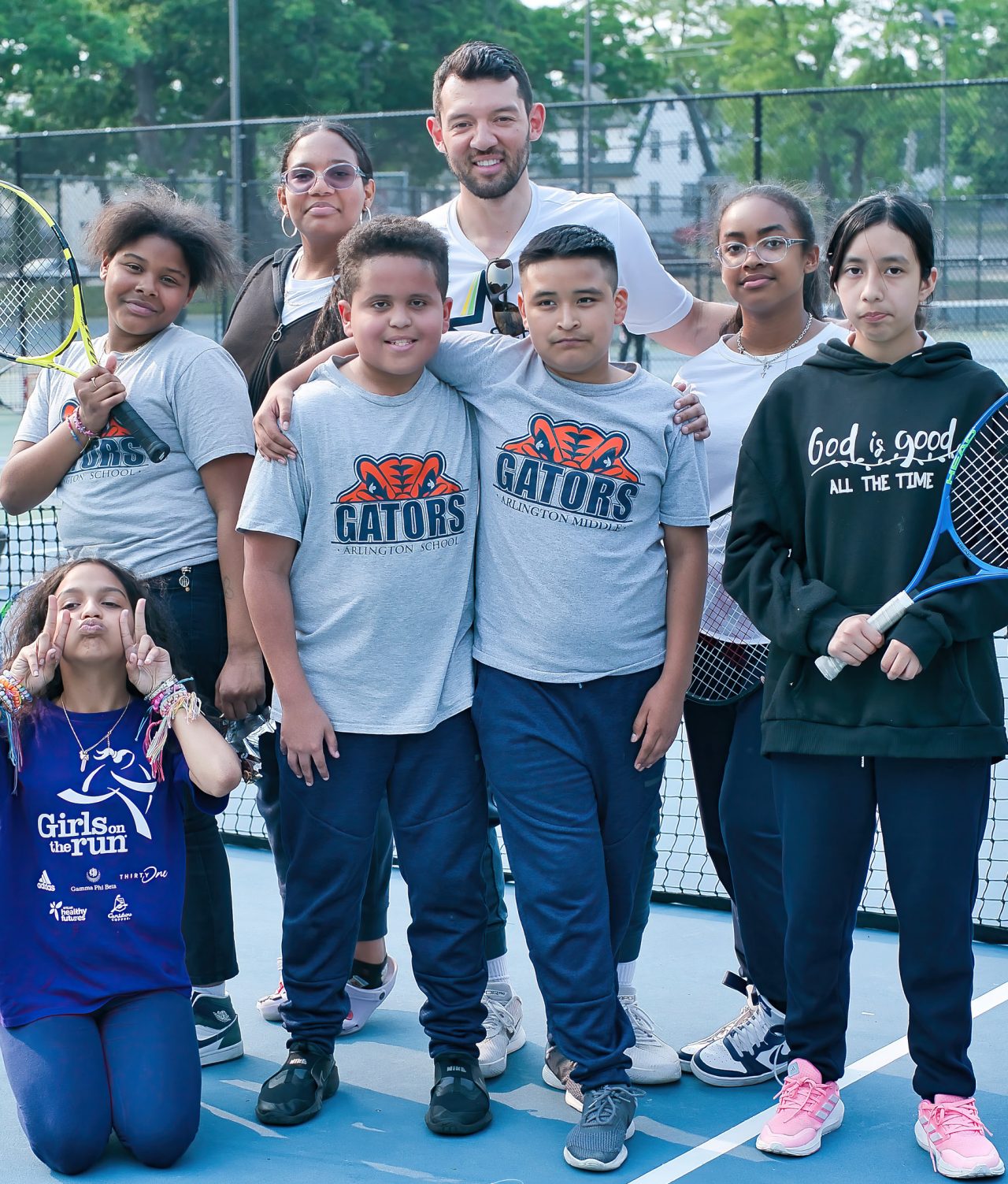 Skinner is a former captain on the Boston College Men's Tennis team and current Director of Tennis at Spark Fitness & Tennis.
Creator
Alex builds things to fix what bugs him on court. Take feeding 105 for four and a half hours straight. Every feeder knows the moment. Someone says, "Hey, Alex." You look up. The score is gone.
So he built a scorekeeper with AI. He isn't a software engineer. Coaches at several clubs now use it. The tool gives coaches back their attention. Next came CoachesLab, a platform for drills, lesson plans, and programs, built with his father. It is now its own company.
Today AI runs through his whole workday. It reads his email, checks enrollments, and drafts replies. When a coach needs a sub, it logs the request, reminds him a week out and again three days out, and updates the schedule once coverage is set. "It's helping me not drop the ball."
All In
Being all three has a cost. A colleague once told him, "You can do 70 percent of the things at 100 percent, or 100 percent of the things at 70 percent. You can't do 100 at 100." He admits he is still bad at it. He and his wife, a teacher at the Pike School in Andover, have a young child and a second on the way. Chatham, two and a half hours from home, was one of the things he let go.
The Question
Alex is a teacher, a builder, a relator, and a meaning seeker. Brooks and Chatham fed all of that at once. People there mattered to him, and he mattered to them. At Spark, his work runs through others. He leads 25 coaches at two clubs, one rebuilt from almost nothing.
I asked him how he'll create the engagement he had at Brooks and Chatham. "That's the one," he said.
He has a start. "Now I'm serving coaches. If I serve the coaches well, they'll serve the members well." He wants his coaches to grow, not teach the same classes forever. He wants members to feel cared for, not run through "a factory."
Someday he hopes to return to a school campus. He calls it "almost like a move home." He may not need to return. He may be building his own campus at Spark.
SIDEBAR
Alex Skinner's AI Advice for Coaches:
- Start with communication. You're on court all day while your phone buzzes. Let AI track your messages, calendar, and reminders.
- Tell it your whole job. "Go talk to it. Tell it all your workflows." It will show you where it can help.
- Have it ask you questions. Give it everything you know, then ask what it needs. "It'll pull out some of these incredible stories you had locked away."
- Teach it, don't fix it. If you edit the output yourself, it makes the same mistake next time. Correct it in the chat. When it gets something right, have it save that as a skill.
- Set guardrails. Alex's AI never sends an email. It only drafts. He also turns off the setting that lets companies train on his data.
- Use it as a thinking partner. Lay out a lineup decision and ask what it sees. It can spot a doubles partnership that works "and here are the numbers to prove it."
- Try it again. "If you tried AI six months ago, try it again today. It is a world of difference."
Related Articles
-
 Colburn Wins ScholarshipAugust 25, 2023The University of Southern Maine (USM) is gaining something truly special with incoming freshman, Clare Colburn. The recent Lincoln Academy graduate has grown into a natural leader both on the tennis courts and off, and it’s largely thanks to her small community of Damariscotta, ME and those around her throughout her childhood. Read More
-
 and another player with trophies at Boys' 18s National Championships.") 2023 Scholar AthletesAugust 08, 2023The USTA announced that Xander Barber, of Falmouth, Maine, was named the male recipient of the 2023 USTA National Junior Scholar Athlete Award. Barber recently graduated from Falmouth High School after relocating to Maine from Asheville, N.C., ahead of his senior year. His impact on the tennis court was felt immediately as Barber led Falmouth to a state championship and was named the state’s Player of the Year. Read More
-
 Junior Sectionals 2023June 21, 2023An action-packed four days of top-notch junior tennis commenced on Tuesday, June 20 at Amherst College, as eight players took home the ultimate prize in New England – Junior Sectionals Champion. Read More


Sign up for our Newsletter
Download the USTA App

