Two Rhode Island Facilities Get USTA Award

USTA New England is proud to announce that two Rhode Island-based tennis facilities received prestigious ‘Outstanding Facility Awards’ from USTA.
The International Tennis Hall of Fame/Hall of Fame Tennis Club in Newport and the Prout School in Wakefield are among 25 winners in the USTA’s annual Outstanding Facility Awards program, which recognizes excellence in the construction and/or renovation of tennis facilities throughout the country.
The Hall of Fame Tennis Club at the International Tennis Hall of Fame (ITHF) is regarded as one of the most treasured shrines to our sport, including the ITHF Museum. The Hall of Fame Club’s courts, 13 grass courts, six hard courts, and one clay court, are all open to the public. There is a long, storied history at the club having conducted the first-ever US National Championships. The facility offers a wide range of programs for all levels of tennis players and also hosts the ATP 250 Hall of Fame Open, the only professional grass court tournament in North America.
The Prout School has taken many steps to be a leading tennis facility in the area. They have resurfaced and installed lighting on all of their six full size courts, six 60-foot blended line courts, and four 36-foot blended line courts, to ensure every age group and skill level has the ability to play. Their close proximity to the Tennis Hall of Fame generates a good deal of interest in the sport, which the Prout School has taken advantage of. The introduction of summer camps has also greatly increased usage.
To be considered for an award, facilities must be under the jurisdiction of a park and recreation department, an educational institution, a nonprofit corporation or be a private or commercially-owned-and-operated facility that offers both USTA and public programming designed to help grow tennis.
Facilities were judged on the following criteria: overall layout and adaptation to site; excellence of court surface and lights; ease of maintenance; accommodations for players, spectators and press/officials; aesthetics; graphics (including the use of signs and landscaping); amenities such as casual seating for spectators, food services and social areas; and the facilities’ participation in USTA programs.
Nominated facilities were voted on in the following categories: Public Courts that are either small tennis centers with 2-10 courts or large tennis centers with 11 or more courts; Private Facilities that support the USTA and other “growth of the game” programs open to the public; and Educational Institutions such as colleges, universities, public and private grade schools, middle schools, or high schools.
All 2021 award winners will receive a wall plaque and an all-weather sign, which can be mounted at the facility. One of the award winners will earn the prestigious “Featured Facility of the Year” designation and be honored as part of the USTA’s Semi-Annual Meeting later this year.
Click here to see the full list of recipients.
Related Articles
-
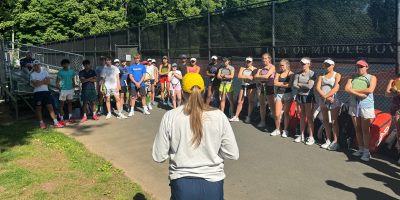
 The Power of QuestionsOctober 02, 2026At my first team meeting at the University of Denver, I put the team into groups of three and asked them to list the essential features of a healthy relationship between two players. These nine players came back with fifty-two unique ideas. 52! I was good for 10 or 15, but not 52. What struck me was how much they already knew, the wisdom that the question uncovered. Their collective knowledge had been there all along, in a room full of college students I had assumed I needed to teach. But no one had ever asked them this question. Read More
 -
 Sharon Murphy SpotlightAugust 18, 2026"This is stupid." That was the verdict from a group of kids at a summer club in Glastonbury, CT, the first time Sharon Murphy laid caution tape across the length of the court, creating six 36-foot courts on one full-size tennis court. The kids wanted to know why. Why couldn't they just play with the yellow ball? Read More
 -
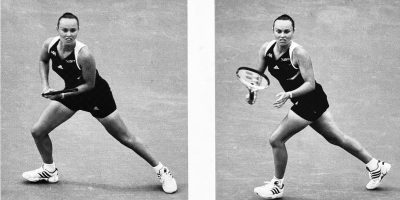
 Gravity is UndefeatedAugust 18, 2026When I was 34, I heard Stan Smith give a lecture on the role of the head in posture and balance. Being a young, all-knowing coach at the time, I thought it was obvious. Of course posture and balance matter. Seven years later, I had an epiphany. I finally saw what true posture and balance actually look like. It is not obvious. Not even close. I had to pay attention. Close attention. And in my experience, it is the root cause of most technical errors coaches are trying to solve. But once you see it, posture and balance become an essential part of your technical lens. Read More
Sign up for our Newsletter
Download the USTA App

