Tri-Level Nationals Unite New England Players
SURPRISE, AZ - USTA Adult League Nationals are back. After nearly a year of canceled championships, New England League teams returned to the national stage for the first time since before COVID-19 hit the United States.
Men’s and women’s 3.5, 4.0 and 4.5 Tri-Level teams joined forces and competed as Team New England from March 5-7 at the USTA League Tri-Level National Invitational in Surprise, AZ.
This year’s invitational looked a little different with extreme safety measures and protocols put in place. Teams were only permitted in the facility when playing a match, temperatures were taken upon entrance, masks were always required except while playing, and social distancing was stressed.
That didn’t stop the New Englanders however, who came ready to play and to enjoy their experience to the fullest.
“USTA did an amazing job making us feel safe. We had a great time at Nationals where our team really bonded. The experience was thrilling and once in a lifetime, said Beth Brause,” New England women’s captain.
Brause, who plays out of Guilford Racquet Club in Guilford, CT, was joined in Arizona by co-captain Sharon Marczewski and six other Guilford teammates as well as new teammates, Lana Arau and Kerry McCormick, from Maine.
“We all shared our great love of the game and our excitement for playing with such tough competitors. Getting to know our own Maine 3.5 girls was one of the best parts. The two girls played all four matches and they were so nice and enthusiastic off the court but so tough and competitive on the court,” Brause said.
On the men’s side, Connecticut and Maine shared a similar bond. Nils Boenicke, who plays out of Kings Highway in Darien, CT, captained the team composed of his 4.5 partner, Neal Collins, two other Connecticut pairs and a duo from Maine, Alan Toothaker and Ben Beverly.
“We all wanted to do well together and represent New England. We had most meals as a team and became pretty tight by the end. This was a great bonding experience for us,” Boenicke said.
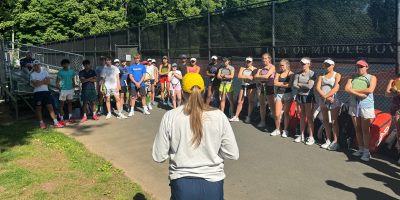
 USTA New England teams at Tri-Level Nationals in Surprise, AZ.
 USTA New England teams at Tri-Level Nationals in Surprise, AZ.
 USTA New England teams at Tri-Level Nationals in Surprise, AZ.
 USTA New England teams at Tri-Level Nationals in Surprise, AZ.
 USTA New England teams at Tri-Level Nationals in Surprise, AZ.
 USTA New England teams at Tri-Level Nationals in Surprise, AZ.
 USTA New England teams at Tri-Level Nationals in Surprise, AZ.
- USTA New England teams at Tri-Level Nationals in Surprise, AZ.
- USTA New England teams at Tri-Level Nationals in Surprise, AZ.
- USTA New England teams at Tri-Level Nationals in Surprise, AZ.
- 4
- 5
- 6
- 7
While both the men and women played tight matches all weekend long, including the men taking eventual champion, Texas, to two super tiebreaks, both teams finished 0-4. Adjusting to the elements was one factor the captains agreed contributed to their results.
“We knew that the competition was going to be challenging. We knew that many teams play outdoors all year round and this was going to be an easier transition,” Brause said. “We really just wanted to get the experience of Nationals, which was a bucket list for many of us and have a great time enjoying each other’s company and getting to absorb the tournament atmosphere.”
“We had no real expectations of reaching the semifinals. Coming in the middle of winter, only playing once a week then going outdoors and competing against teams from warm weather is always tough,” Boenicke added. “We noticed other teams coming from the north and northeast shared similar struggles while the warm-weather teams generally played better.”
The women fell to teams from Florida, Eastern, SoCal and Southwest, while the men lost to opponents from Mid-Atlantic, Middle States, Texas and Northern.
While everyone came from different regions, climates and preparations, one thing linked all teams: the ability to play tennis.
“We were all serious, but no one took it too seriously out there. No officials were called, no one was yelling or screaming or getting carried away. Everyone echoed the same sentiment that they were just happy to be out there,” Boenicke said.
“We are thrilled that the worst of COVID-19 is behind us and our own wonderful sport is moving forward unscathed. Tennis is an important part of our lives and really therapeutic for us, which is why we named our team, 'Net Therapy,'" Brause said.
“Going to Arizona was really the culmination of a terribly sad, scary year and a celebration that we made it through the tough challenges. Our entire team was proud and privileged to represent USTA New England and appreciate all the hard work that our section devoted to make it happen.”
The majority of New England players selected for Nationals were able to compete, however teams were missing a few players due to COVID-19 positive tests or restrictions. The men’s team was notably without original captain, Doug Presley, who was unable to attend due to travel restrictions.
The full men’s Nationals roster was: Nils Boenicke & Neil Collins (4.5), Alan Toothaker & Ben Beverly (4.0), Henric Babtist & Walid Bouzouita (4.0), Albert Kim & Anthony Milio (3.5)
The full women’s Nationals roster was: Beth Brause, Elisa Milano, Melissa Page and Kerry Shay (4.5), Sharon Marczewski, Theresa Panico, Signe Breeden and Sarah Sandora (4.0), Lana Arau & Kerry McCormick (3.5).
Complete Tri-Level Invitational results can be found here.
Related Articles
-
 The Power of QuestionsOctober 02, 2026At my first team meeting at the University of Denver, I put the team into groups of three and asked them to list the essential features of a healthy relationship between two players. These nine players came back with fifty-two unique ideas. 52! I was good for 10 or 15, but not 52. What struck me was how much they already knew, the wisdom that the question uncovered. Their collective knowledge had been there all along, in a room full of college students I had assumed I needed to teach. But no one had ever asked them this question. Read More
 -
 Sharon Murphy SpotlightAugust 18, 2026"This is stupid." That was the verdict from a group of kids at a summer club in Glastonbury, CT, the first time Sharon Murphy laid caution tape across the length of the court, creating six 36-foot courts on one full-size tennis court. The kids wanted to know why. Why couldn't they just play with the yellow ball? Read More
 -
 Gravity is UndefeatedAugust 18, 2026When I was 34, I heard Stan Smith give a lecture on the role of the head in posture and balance. Being a young, all-knowing coach at the time, I thought it was obvious. Of course posture and balance matter. Seven years later, I had an epiphany. I finally saw what true posture and balance actually look like. It is not obvious. Not even close. I had to pay attention. Close attention. And in my experience, it is the root cause of most technical errors coaches are trying to solve. But once you see it, posture and balance become an essential part of your technical lens. Read More
Sign up for our Newsletter
Download the USTA App

