North Carolinian aims to return to tennis after leg amputation
Her goal: return to playing tennis. The journey: receive funding for an athletic leg. The solution: a bill in the North Carolina State Legislature.
Reagan Perry, 23, first noticed the pain in her left leg while playing tennis in 2017. Perry thought she just had shin splints and decided to wait to get it checked out.
The Kinston, N.C., native believed her high school team had a good chance to win the state championship and wanted to help in any way possible, even if she wasn’t at full strength.
But after the final match of the season, the 15-year-old sophomore walked off the court and told her parents she needed to see a doctor.
 Reagan Perry shows off her trophy and competes in high school tennis. Courtesy of Reagan Perry
“I got an x-ray, and they didn't even review it with me. They just told me I needed to go to Chapel Hill, which was the big hospital in my state,” Perry said. “I ended up there with an orthopedic oncologist. After a couple biopsies, they confirmed I had a 7 ½-inch non-cancerous bone tumor.”
The doctors told Perry they could remove the tumor and likely have her back on the court again. But that wasn’t the case. It turned out to be a recurring tumor and came back three times bigger each time.
Perry incurred more than 15 surgeries over the next few years. By the time she was a junior at North Carolina State in 2023-24, she’d undergone a full knee and shin replacement.
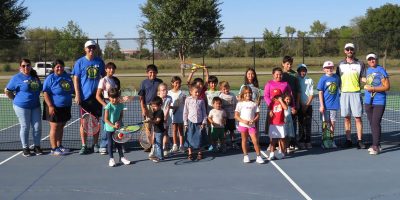
 Reagan Perry, second from left, with her tennis-playing junior friends. Courtesy of Reagan Perry
“My left leg was basically completely metal from a couple inches above my knee right to my ankle, and it still wasn't better. I still had a ton of pain,” Perry said. “I couldn't bend my knee, and the remaining surgical options were non-existent unless I did amputation.”
Next step: amputation
Perry’s pain and immobility were hindering her quality of life. In January of 2024, she decided to have her leg amputated.
“The goal was always to get back to tennis, and when I got my leg amputated, it felt so freeing in my head. I'm going to be able to move pain free. I'm going to be able to get back to tennis,” Perry said. “But once I found out that insurance wouldn't pay for an athletic leg, it was like tires screeching. It was like everything hit the brakes. What did I just do? I've lost my leg, and now, if my parents can't afford $50,000 for the leg, I can't play tennis. I thought that was crazy.”
Perry’s experience led to the creation of Reagan’s Law, legislation introduced this year in the North Carolina General Assembly that would require insurance companies to expand their coverage to provide patients with access to custom orthotics and prosthetics. Named after Perry, the bill was passed unanimously by the North Carolina House. It is currently being debated in the Senate.
Perry worked with the national organization, So Every BODY Can Move, to help find state legislators to sponsor this type of bill. Perry’s father, retired Republican state Sen. Jim Perry, was already out of office by the time the bill was created. But some of his former colleagues saw the need for legislation.
“I was fairly old when this happened to me. I've already played sports. But if there is a kid born without a leg or loses their leg when they're 5, they're never going to play a team sport. They're never going to be active unless their parents can afford it,” Perry said. “I think the $50,000 estimated cost is just way out of the water for the average person.”
Encouraging exercise
Given the obesity crisis in the country, Perry believes insurance companies should be supporting ways to help patients without limbs to be active.
“You go on any insurance company's website and they have a fitness section and a wellness section and they encourage exercise. They encourage all these things, but they don't encourage exercise for amputees because they're not going to pay for the equipment you need to do that?” she said. “It just doesn't make any sense. It’s not logical.”
Perry’s health ordeal has inspired her to apply for medical school. She grew up wanting to be a veterinarian, and her orthopedic oncologist, Will Eward from Duke Health, is a medical doctor and a vet. He advised her to pick one, and Perry feels the medical route would allow her to help others in the same situation as her.
“All it took was a few good doctors to believe in me and to push for me to get the tests I needed, the care I needed, to kind of change my life and make sure that I could be pain free one day,” she said. “I think that's what solidified my desire to go into medicine. I want to stand up for people and believe them when they say that they're in pain, instead of just telling them they're crazy.”
Perry is relearning how to walk again after having another surgical procedure in May. Once she gets strong enough, she will begin trying to get an athletic leg. Perry plans to continue fighting to get Reagan’s Law passed and ensure patients with limb losses can afford to live an active life with help from insurance companies.
Perry already knows the first thing she’ll do once she gets a new sports prosthetic. She’ll return to the tennis court and rekindle a love that has only grown stronger through her absence.
“It's going to be emotional,” she said. “I still get emotional even when I'm watching tennis, because I've given so much to try to get back to this, and I'm still not there. Like, how much longer do I have to wait? But I'm super excited.”
Related Articles
-
 USTA Southern BoardOctober 16, 2026USTA Southern announced that Drew Meyers, of Zwolle, LA, was nominated to serve as USTA Southern Board of Directors President & CEO for the 2027-28 term. Read More
 -
![Visit the NJTL EMERGES IN ARKANSAS page]() NJTL EMERGES IN ARKANSASOctober 12, 2026Mirna Ordoñez has launched an NJTL to support Hispanic and other underserved youth in Springdale, Ark. Read More
NJTL EMERGES IN ARKANSASOctober 12, 2026Mirna Ordoñez has launched an NJTL to support Hispanic and other underserved youth in Springdale, Ark. Read More -
 Hispanic Heritage MonthSeptember 23, 2026Hispanic Heritage Month: Yannik Alvarez and his father, Gilly, talk about Puerto Rico, the island where the elder Alvarez played on the Davis Cup team and the junior champion now represents. Read More

Sign up for our Newsletter
Download the USTA App

