Scotty Moore: From his start as a high school official to his seat in the US Open chair
It was 2022 and Scotty Moore was ready to walk out onto the Arthur Ashe Stadium Court to chair his first US Open final.
An experienced official gave him just three words of advice: “Don’t look up.”
For even veterans of thousands of chaired matches, entering a venue where up to 22,000 fans are looking down and hearing your every word, the experience can be nerve-racking.
“It's definitely, despite maybe my first chair back in 2013, probably the most nervous I've been on a tennis court. You get through the warm-up, you get through the first game and then you start to relax. It all becomes just muscle memory.”
 Scotty Moore starts the coin toss for the 2024 US Open women's doubles final. USTA
Last year he chaired his second US Open final, the women’s doubles. Just like when he officiated the 2022 mixed doubles final, he received national recognition during the televised trophy presentation.
Started in high school
Growing up in North Carolina, Moore, 29, caught the officiating bug in high school. “I needed some service hours, so I volunteered at a tournament, and I really liked how the tournament ran.”
For last week’s interview, Moore was in Sumter, S.C. That’s where he took his first line umpire clinic with former USTA Southern volunteer Meg Farrelly in 2013. “I stepped on the court at a women's $10K in Sumter and it was like the best thing I've ever done.”
After college, he moved to South Carolina and, as he became more experienced, he began chairing up to 250 matches per year. He also served two terms volunteering on USTA Officials Committees at the state, sectional and national levels.
While many new officials often move up the officiating ranks slowly, Moore was in a chair within months of certification. He was still in school at the University of North Carolina – Wilmington when he took a major career step by going to Mexico to take the test for the first rung of professional chairing. “I think I was the youngest in the class” when earning a white badge.
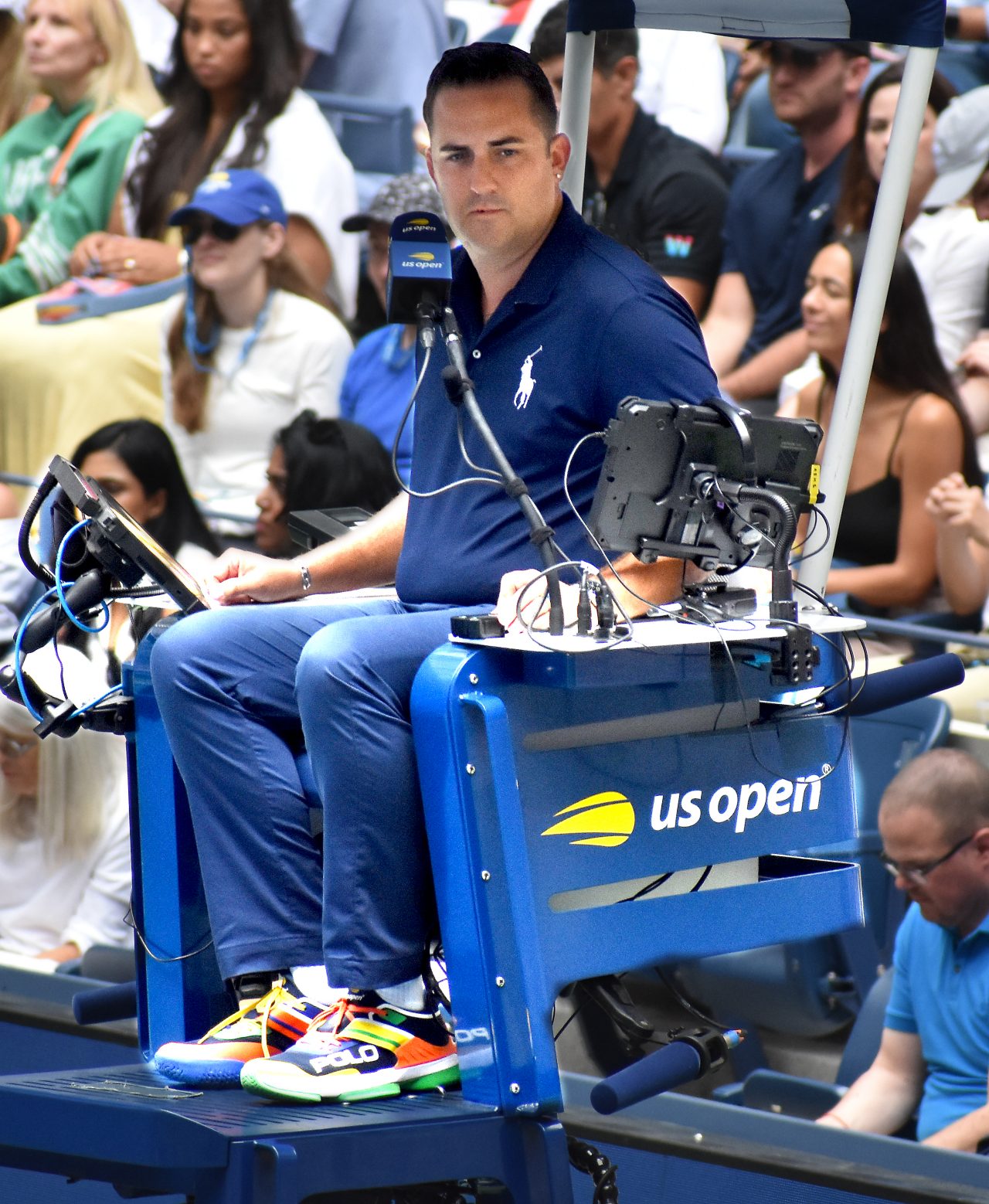 Scotty Moore in the chair at the US Open. USTA
Since then, he obtained his bronze and silver badges, now holding the second-highest-level badge. There are only about 50 silver badges in the world.
Over the last seven years, he’s traveled the world, working all four Grand Slams, along with matches in Asia.
“They have tournaments all over their countries. So, I get to visit the small cities that you wouldn't normally visit. Tourism is pretty interesting for me,” he explained.
New York energy at the US Open
However, he said, nothing really compares to the energy and atmosphere at the USTA Billie Jean King National Tennis Center in New York.
“It's an environment like no other. You have tennis fans. You have sports fans. You have people that are just there for entertainment value. I love the outer courts at the Open. In the first few days of the tournament, there's some really big matches out there.
“I will say that New York is among the hardest tournaments in the world to deal with the crowd. It can be challenging at times and it can be taxing. And I know for me it's a lot easier to focus if I have an intense crowd, a crowd that is cheering a lot.”
Moore’s workload in New York can be one or two chairs a day, with a day or two off, while some officials at a lower level may be doing matches every day.
He also talked about working with electronic line calling, now the standard for virtually all pro matches. “It definitely feels a bit more lonely on court. You used to have seven (line judges) out there with you.”
It may be a bit lonely for Moore when he looks down at the court. But, when he looks up, there are thousands of tennis fans relying on his experience and expertise.
Related Articles
-
 USTA Southern BoardOctober 16, 2026USTA Southern announced that Drew Meyers, of Zwolle, LA, was nominated to serve as USTA Southern Board of Directors President & CEO for the 2027-28 term. Read More
 -
![Visit the NJTL EMERGES IN ARKANSAS page]() NJTL EMERGES IN ARKANSASOctober 12, 2026Mirna Ordoñez has launched an NJTL to support Hispanic and other underserved youth in Springdale, Ark. Read More
NJTL EMERGES IN ARKANSASOctober 12, 2026Mirna Ordoñez has launched an NJTL to support Hispanic and other underserved youth in Springdale, Ark. Read More -
 Hispanic Heritage MonthSeptember 23, 2026Hispanic Heritage Month: Yannik Alvarez and his father, Gilly, talk about Puerto Rico, the island where the elder Alvarez played on the Davis Cup team and the junior champion now represents. Read More
Sign up for our Newsletter
Download the USTA App

