Texas Junior Stars Shine on World Stage at Wheelchair Tennis World Team Cup in Belgium
 Left to right: Lily Terral, Jeremy Perez, Mattingly Bristow
KNOKKE-HEIST, Belgium — Representing your country on the world stage is a milestone most athletes only dream of. For three Texas junior wheelchair tennis stars, Jeremy Perez of Joshua, Mattingly Bristow of Weatherford, and Lily Terral of Houston, that dream became a reality this past May.
They traveled to Knokke-Heist, Belgium, to compete in the prestigious International Tennis Federation (ITF) BNP Paribas World Team Cup Junior Festival. The 2026 tournament marked a historic milestone for the sport, introducing separate standalone boys’ and girls’ divisions for the first time. The American boys’ squad fought their way to a hard earned fourth place finish, while the U.S. girls’ team captured the bronze medal, placing third overall.
Following their international performances, Perez and Bristow sat down to discuss their unique beginnings in adaptive sports, the stress of transatlantic travel with specialized athletic gear, and the unforgettable camaraderie of competing for Team USA.
Q&A: Jeremy Perez and Mattingly Bristow
USTA Texas: Let’s start at the beginning. How were you first introduced to wheelchair tennis, and what did your early journey look like before you started competing at this elite level?
Jeremy Perez: I first got introduced to wheelchair tennis at an event called the Kinetic Games when I was 6 years old. I remember getting into a sports chair and just going off by myself, always hitting the ball. Every year, whenever I finished up with shot put and the track and field stuff, I’d just head straight over to the tennis courts. It felt like something inside of me was calling. I started taking the sport really seriously in 2021, and it’s just been a steady progression from there.
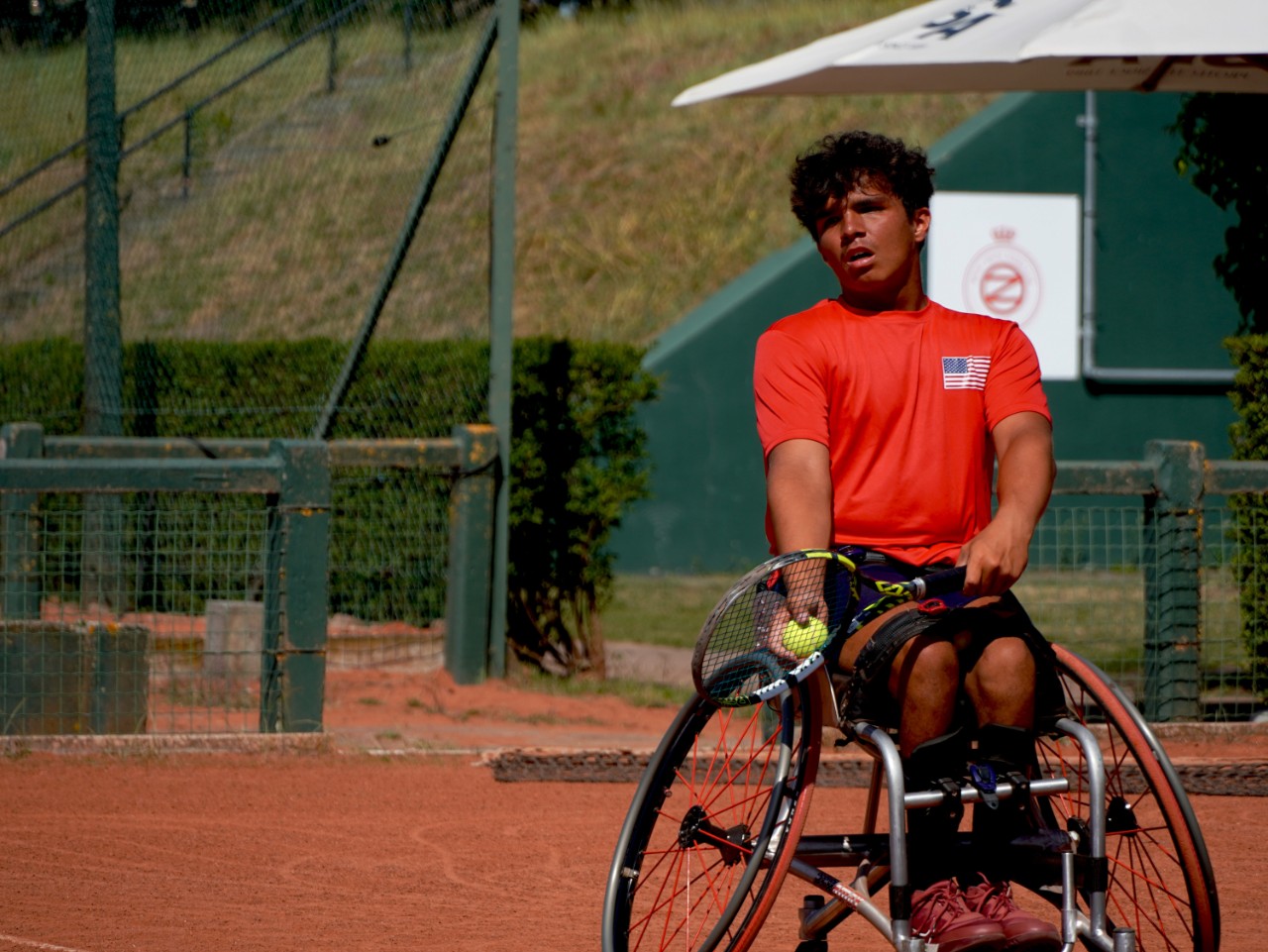


Mattingly Bristow: For me, I first heard about it around 2019 when I was 8 years old at the Abilities Expo. They had all kinds of different adaptive sports to try, and tennis was the one I liked the most. I was actually doing dance, softball, and baseball at the time, so I didn't fully commit to tennis until I was about 10 or 11. My journey really took off by showing up to practice every single week in Coppell, sometimes hitting at SMU, and playing on the courts near my house with my dad anytime I could.
USTA Texas: How did you first learn about the World Team Cup, and what was the moment like when you found out you actually made the 2026 U.S. national team?
Perez: I found out about the World Team Cup back in 2023 when my friends Charlie Cooper and Tomas Majetic were on the team. I went to a camp with them and their national coach, and they shared their experiences. Fast forward to this year—I had just finished up a practice session when I checked my phone. I had an email saying, "Congratulations, you’ve made it." It was a lot of text to read through, but seeing "Jeremy Perez, you are on the World Team Cup" gave me major butterflies. It was a completely surreal moment.
Bristow: I really started tracking it in 2025 because my friend Lucy [Heald] was playing in it for her first time. When the selections came out this year, the confirmation was actually emailed to my dad while I was sitting in English class. He texted me to say we got an email, but he didn’t tell me what it said right away—he was totally teasing me! I was freaking out and so nervous for about 10 minutes until he finally revealed that I made it. I was so excited and relieved because I knew this tournament was the exact next step I needed to grow my game.
USTA Texas: Traveling internationally is tough enough, but traveling with specialized sports wheelchairs adds another layer of complexity. What was the journey to Belgium like?
Perez: The travel part was long and, honestly, pretty boring—there weren’t enough good movies on the plane! It was an eight-hour flight from Atlanta to Belgium, and I didn’t sleep a single wink. Going to a new country and a new time zone makes you nervous. I was definitely anxious about my chair because we had never flown internationally with it, and I didn’t want it to get bent or banged up by the airlines. But once we landed, got onto the court, and got situated, all those nerves went away.
Bristow: This was my very first time leaving the United States, so it was incredibly exciting but also really stressful. We flew from Dallas-Fort Worth to Atlanta, but our flight got delayed and we missed our connection to Belgium. We had to reroute through Amsterdam. Because I flew out a bit later so I could watch my brother graduate from high school, it turned into a massive time crunch. I landed at 4 p.m. the day before the tournament started, waited until 6:30 p.m. for the bus, and had to leave for the courts by 8:15 a.m. the next morning. The pure excitement and adrenaline kept my energy up through the jet lag.
USTA Texas: Once you rolled onto the clay courts in Knokke-Heist, how did the actual international competition match up against your expectations?
Perez: It was a genuine eye-opener. The international players were so much better than what I had been hearing about. But I didn't look at them and think, "Oh, I'm going to lose." I looked at it as an opportunity to share the court with them, bring the fight to them, and make them earn every single point. Some of these kids have been training with national coaches since they were 6, and I only started in 2020. Seeing that I could hold my own and compete hard against them made me pretty giddy with my progress.
Bristow: Going into it, I knew the field would be tough, but I completely underestimated how well I could actually compete with them. I went to Belgium just hoping to win maybe a single match, and I ended up winning three! Knowing I can step on the court and beat international players gave me a massive boost of confidence and a ton of motivation to keep training.
USTA Texas: What are the standout moments or matches that you will remember for the rest of your lives?
Perez: My absolute favorite match was playing a Japanese player named Hiroi. The kid can absolutely pound the ball from any spot on the court. Playing someone like that forces you to dig deep, rival their intensity, and just have fun instead of getting frustrated. I also won my first-ever international match in a tight third set, which was huge because I was so visibly nervous at the start.
Outside of my own matches, a moment I'll never forget was watching the U.S. girls' team offer their medals to players from Sweden and Spain. Those girls had to compete under a combined "Team Europe" banner because their individual countries didn't have enough players to form official national teams, meaning they weren't eligible for medals. The U.S. girls sharing that podium moment was incredibly special.
Bristow: For me, it was the daily connection with my teammates and how we constantly lifted each other up. We did a massive amount of cheering from the sidelines. Even when one of us was down in a match, the energy from the team helped us shake it off and regain our confidence. On the social side, it was so cool connecting with other countries. We hung out with the Australian team—Sunny, Arlo, and Josh—and I learned that in Australia, if you get 10 demerits on your driver's license, they take it away completely. It was fun talking about everyday life things like that.
USTA Texas: Wheelchair tennis is growing rapidly. What would you say to a young person with a disability who is considering trying the sport, or to an able-bodied player who doesn't know much about the game?
Perez: I would tell them: ‘don't let being in a chair hold you back.’ Think about it—you actually have more wheels than a standing person has legs! I honestly look at it as a great advantage. Plus, we only have to use our arms instead of running around the court looking like maniacs. Just get out on a court at least once. Find someone at your level and just hit back and forth for an hour. And remember, you don't have to find another wheelchair user to play—you can play with an able-bodied friend. The ball is allowed two bounces in wheelchair tennis, but otherwise, it's the exact same game.
Bristow: Just go out and try it, because taking that first step is the best thing you can do. If you enjoy it, stick with it. It opens doors to incredible international opportunities and friendships that you would never think are possible. To able-bodied players, I just wish they knew that being in a wheelchair doesn't mean you can't play high-level, highly competitive sports. For a long time, people just didn't have the resources or the media coverage to see adaptive sports, but the visibility has grown so much over the past few years. We are out here playing hard.
Related Articles
-
") 2026 Mixed 18+ SectionalsSeptember 21, 2026Teams from across Texas faced off September 18-20 in Tyler for the 2026 USTA Texas 18 & Over Mixed League Section Championships. Read More
2026 Mixed 18+ SectionalsSeptember 21, 2026Teams from across Texas faced off September 18-20 in Tyler for the 2026 USTA Texas 18 & Over Mixed League Section Championships. Read More -
 OTOT: Hector LopezJuly 07, 2026From a young age, Hector Lopez has possessed a deep love for tennis, viewing the sport not just as a game, but as a powerful pathway toward a brighter future. Read More
 -
 OTOT: John ZavalaJune 24, 2026For John Zavala, tennis is a lifeline that proved there is always a next point. Read More
Sign up for our Newsletter
Download the USTA App

