Women’s History Month: Amanda Moore Inspires the Future of Women in Sports
Originally from Calabasas, Calif., Amanda Moore was an All-American tennis player at the University of Southern California before competing on the pro tour for three years, where she reached a Top 300 WTA ranking in singles and doubles. She has been a dedicated USTA volunteer at the local level since 2017 and is also a USTA Cardio Tennis trainer and an industry speaker.
As a part of our Women's History Month spotlight series, Moore shared insights into her transition to the Texas tennis community as well as taking on leadership roles on the Board of Directors with both USTA and USTA Texas. She discussed how she is playing a part in helping develop key USTA Initiatives including supporting the pursuit of 35 million US tennis players by 2035 and serving on the board of the newly-launched USTA Coaching. Finally, she reflected on the work of diversifying coaching as a career and her perspective on how she and others are working to help open more opportunities for women and girls in the future.
Amanda Moore is currently serving her first term on the USTA Board of Directors and USTA Texas Management Committee. She is one of the youngest women to ever serve on both of these leadership bodies. Beyond her national and section-level leadership, Moore is a Teaching Professional at Northwood Country Club in Dallas.
USTA Texas: You've been in Texas for about a year and a half. How has your experience being a part of the Texas tennis community specifically impacted the way that you approach coaching? Leadership? Life? Your opinion on TexMex? All of the above?
Amanda Moore: Getting thrown into [the USTA Texas] Management Committee because of my National Board position right away got me really quickly entrenched in what the Section does and what we're about. I just came from the Southwest Section, which is a very different, obviously smaller, Section – with a very high bar for TexMex. But in terms of my tennis experience, it's given me some really great perspective on different avenues of coaching, different avenues of how tennis can work in different places. I've had to adjust to different crowds of people in my coaching career, up to the different goals that each Section has for what they're trying to accomplish.
We're all trying to get to our same big goal of 35x35, but how each place does that works a little differently. So, I think that one of the biggest things I've learned coming here, aside from the fact that Texas is just awesome in general and we have so many things to be proud of [...] is the knowledge that it's important – as a coach, as a volunteer, as a provider – to really value listening, to really value the kind of perspective you have going into anything you do because it will make you successful. It will get you far just from being able to listen to what other people are saying, being able to add your own flair and thoughts to that, and being able to combine those things and create something special.
"It will get you far just from being able to listen to what other people are saying, being able to add your own flair and thoughts to that, and being able to combine those things and create something special."
USTA Texas: You are one of the youngest women to ever serve on the USTA Board of Directors, and certainly the USTA Texas Management Committee. What or who motivated you to get involved with the USTA at such a high level of leadership?
Moore: Great question, and an interesting stat. I'm so thrilled and proud that that is true. My experience nationally started with the [USTA] Nominating Committee as an Elite Athlete. I am now what I jokingly call an “expired Elite Athlete.” I had another player just reach out to me who had also served before and say, "Hey, this is an opportunity you have as a player. Here's the impact it can make. You should apply." And I think that's a really important thing to remember in all realms of volunteering – just that very personal touch [...] just to say, "Hey, what you do is valuable. Your perspective is valuable.”
Getting that Nominating Committee experience and the knowledge of what the Board of Directors truly does, what it's about, how impactful it can be, was very meaningful to me. So coming off of that experience, I knew that at some point, though I wasn't sure when, especially with my background in coaching, what I bring in general from my playing career and all of the facets that I've been involved in tennis could be useful to what we're doing right now. It was something that I was going to be interested in applying to. I'm not going to lie, I was slightly surprised that it came this early. I mean, I think I deserve to be here, but it never stops that feeling of, "Wow, that's great that a committee had the guts to be able to submit someone like me to this slate." But to answer your question, it was that personal touch from people around me telling me that this was something that could possibly be for me.
USTA Texas: Is this experience what you were expecting or hoping it would be, and how has it differentiated from what your original expectation?
Moore: What I tell everyone when they ask me about this experience is that it's exciting, it's challenging, it's frustrating – it is all the things that I expected and more. I think there is sometimes a lack of understanding of the large amount of things the USTA touches, what an incredible spectrum to be aware of, to be accountable for, to be knowledgeable of, and to work with our staff to support them the best we can [as those] who are handling all these things on the ground. It is what I expected, but also I will say there are realms of it that I'm going to be continuing to learn as I go on.
USTA Texas: How would you say [your National Board experience] has changed you?
Moore: I think I've always been a relatively confident person in what I do, at least as a coach, for the services I provide, and honestly, even locally for what I do in the volunteer space. But it's given me the confidence to really say, “I belong here. What I say and what I think truly matter.” To be able to admit when I make a mistake or when I feel like I've made a misstep, I have the confidence to say, “I screwed up. This is how I can fix it.” Those skills are just absolutely intangible. Having those skill sets – I think I had the base for them before – but being able to step into a true leadership role has given them to me at a whole new level.
"It's given me the confidence to really say, 'I belong here. What I say and what I think truly matter.'"
USTA Texas: As a member of the USTA Board of Directors, you’ve had to become comfortable with presenting to large groups of Section staff and volunteers, clearly communicating complex ideas, and opening the floor up to questions and feedback. Is that a skill that you learned or refined with the help of a coach or a mentor?
Moore: I always reference a woman who is currently directing at a club in Southern California named Cari Buck. [...] She's always been in my corner for lots of things, and I've gotten to watch her go from lots of different ventures – directing clubs, coaching, the managing world, being the GM of a World Team Tennis team. Following the examples of women like that, of being people that were not afraid to step out and stand out, has been really helpful for me to do that. And quite honestly, I've been lucky enough where the bosses that I've worked for at the clubs that I've been at have always been very receptive to my ideas and personality. So I think the combination of seeing strong females being able to stand in leadership positions, and to have understanding of people over me in the past and around me that have been those open sources of saying, "Hey, do you have any questions? Do you have an opinion? Would you like to help?" have definitely shaped the way that I see and approach leadership.
 Amanda Moore, 2025-2026 USTA Board and USTA Texas Management Committee Member.
 Amanda Moore with colleagues Mary Buschmann (left) & Derek White (right) at the 2025 USTA Annual Meeting.
 Amanda Moore (right) with fellow USTA Coaching Women's Cohort member, Jessica McMillen (right) at the 2025 USTA Annual Meeting.
 Amanda Moore in her element coaching on court.
 Amanda Moore competing as a rising junior tennis star.
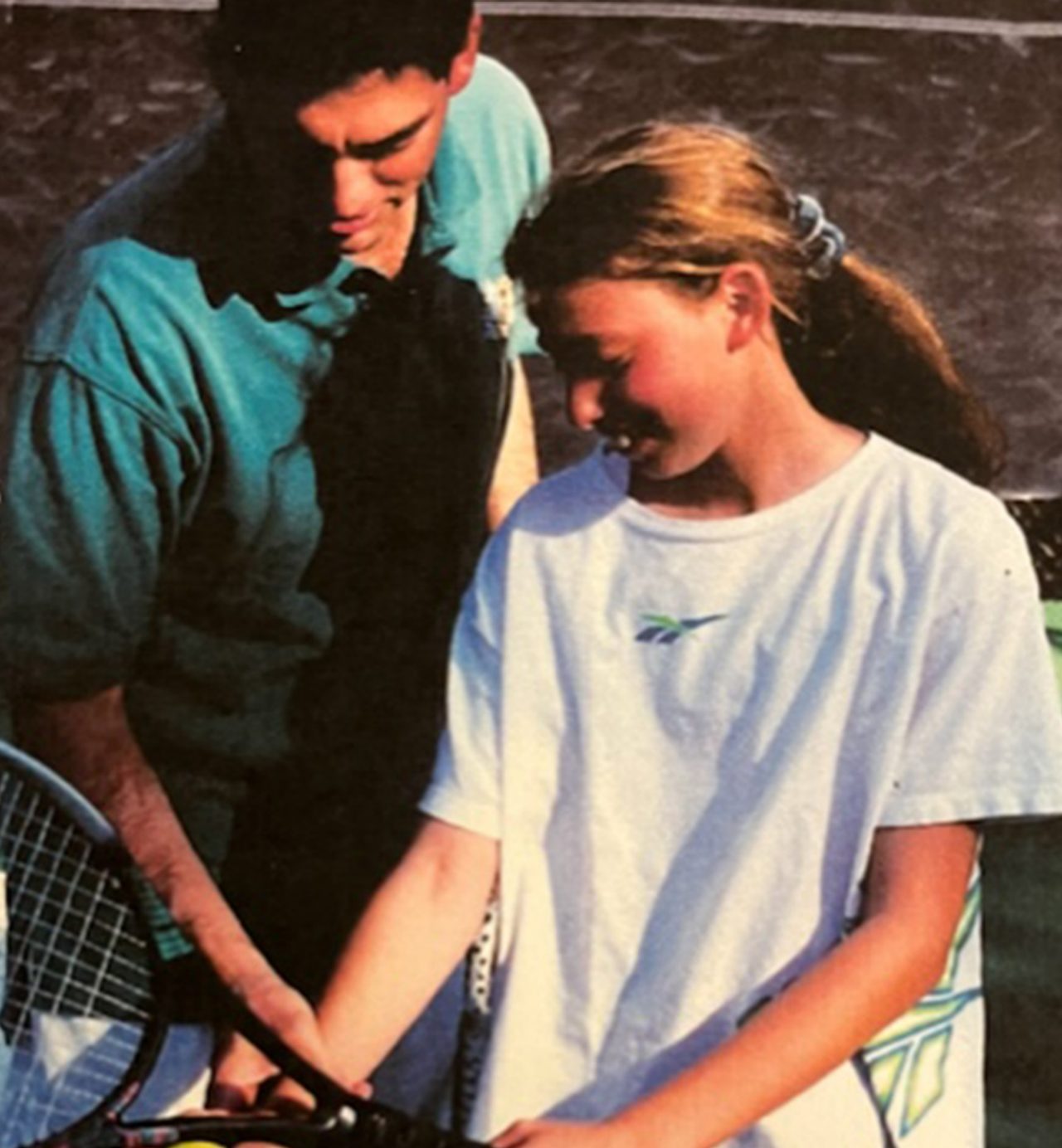 Young Amanda Moore getting serving tips from her coach.
 Amanda Moore's childhood self-portrait as tennis player.
- 1
- 2
- 5
- 7
- 3
- 4
- 6
USTA Texas: Let's talk about big USTA initiatives, specifically USTA Coaching. You've obviously been very involved in the launch and the scaling of that initiative. We know that there's a need for more women and girls in tennis, and we know that there is a need for more women in coaching specifically. What's your perspective on that?
Moore: First of all, I would be remiss if I didn't say, I mean, I sit on that USTA Coaching Board of Directors, but Craig Morris and Megan Rose are the true engines of that thing. It's already exciting to see us be able to recognize when things are going well, things we need to go back to the drawing board on, things we want to continue to pride coaches to be better on.
But in terms of the women's space, you're absolutely right. It is one of the top topics of conversation. How do we get more women to see that this is a viable career, that this is something that they love to do and can stay here? Again, I've been lucky enough where I've had lots of people tap me on the shoulder, and, I'm not going to lie, my playing background helped give me a bump for that. I'm not sure everyone really gets to have that. [...]
What Megan has particularly raised with the Women in Coaching Cohort is a program to pinpoint superstar females in [each Section’s] communities to include them in national level events, coaching seminars, and ways to support people. I think that's a great first step in being able to get toward that goal of including more women and empowering them to see that this is something that can be for them. I will say that I think it's getting better. I'm seeing more and more women start to pop up around me. I just hope that USTA Coaching and I can continue to foster that environment.
"I'm seeing more and more women start to pop up around me. I just hope that USTA Coaching and I can continue to foster that environment."
USTA Texas: What are some of the biggest hurdles or challenges you've seen as a woman in the coaching profession and how have you overcome those?
Moore: One of the biggest challenges is the natural stereotypes I think people make when women are approaching the coaching career. Oftentimes providers pinhole those people into “only children's programming” or “only these women's teams” and don't see that person as a coach, period.
I found that when I started [...] I was actually targeted to do high performance because of my background. And then I very quickly found out that high performance is great, but it's not something that really resonated with me – it's also really difficult by the way – as much as working with beginners under 40 or Cardio Tennis. Cardio Tennis was a big change in how I saw how I could provide tennis. It had movement, it was fast, and it had music, which is another great love of mine. So I got to start to jump into different things.
I think that it is important to not judge a book by its cover and ask that person, "Hey, what works for you?” [...] But I think that one of the biggest hurdles we face is making coaching – not just for women, but for anyone – just a blank canvas as opposed to guessing what you're going to fall into. Let the coach establish that. Let the coach find their own way or be able to to express what they'd like to do.
"One of the biggest hurdles we face is making coaching – not just for women, but for anyone – just a blank canvas as opposed to guessing what you're going to fall into. Let the coach establish that."
USTA Texas: What do you hope the future will look like for little girls, young girls, young women, women pursuing dreams and careers in tennis, in sports in general, in coaching, or just in leadership roles?
Moore: I think it just kind of goes to this overarching theme that we're talking about. My daughter's name is Melody, and I just hope for Melody that in anything she does – I hope it's sport but, who knows – that the sky is always going to be the limit. That there will be no ceiling or no barriers to the things that she wants and can do, and that people can step out and be able to highlight my daughter for what she does well. Obviously, as coaches, mentors, the real world, there's always the things like, “Hey, we need to get better at this.” But I think there is a real big need in sport right now to have that inclusive environment. And that is the best thing that I could wish for my daughter.
"I think there is a real big need in sport right now to have that inclusive environment. And that is the best thing that I could wish for my daughter."
Related Articles
-
 OTOT: Micah LeeOctober 14, 2026What began as a tentative step onto the court for Micah Lee has evolved into a transformative journey defined by resilience, community, and self-discovery. Read More
 -
 2026 Mixed 55+ SectionalsOctober 13, 2026Teams competed in Abilene for the title of Mixed 55 and Over League Champions. Sectionals took place October 9-11, 2026. Read More
 -
 HHM: Sebastian SainzOctober 13, 2026For Sebastian Sainz, Hispanic Heritage Month is more than an annual celebration, it is a daily commitment to representation, community, and honoring the roots that shaped him. Read More



Sign up for our Newsletter
Download the USTA App

